
Table of Contents
If someone asks for the strongest possible permanent magnet, SmCo is rarely my first answer. If the same customer says the magnet will sit next to a hot motor winding, work downhole, or hold a stable field for years with very little drift, the conversation changes. That is where samarium cobalt earns its price.
The companies below are manufacturers I would investigate for different SmCo projects, from small custom parts to aerospace motors and larger industrial programs. Newland is placed first because this ranking gives more weight to engineering flexibility, custom production and international project support than to company size alone. If the ranking were based only on proprietary alloy development or aerospace history, the order would look different.
What is SmCo Magnets?
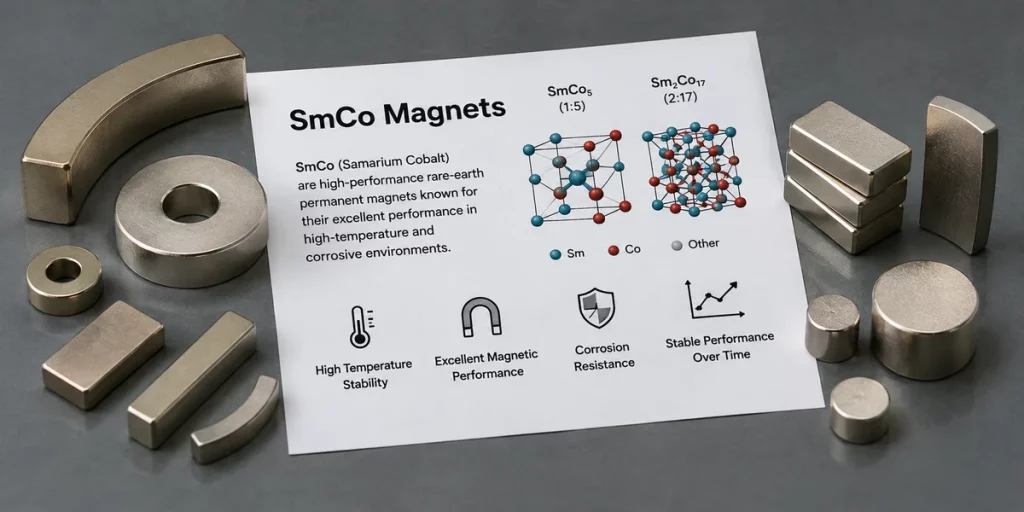
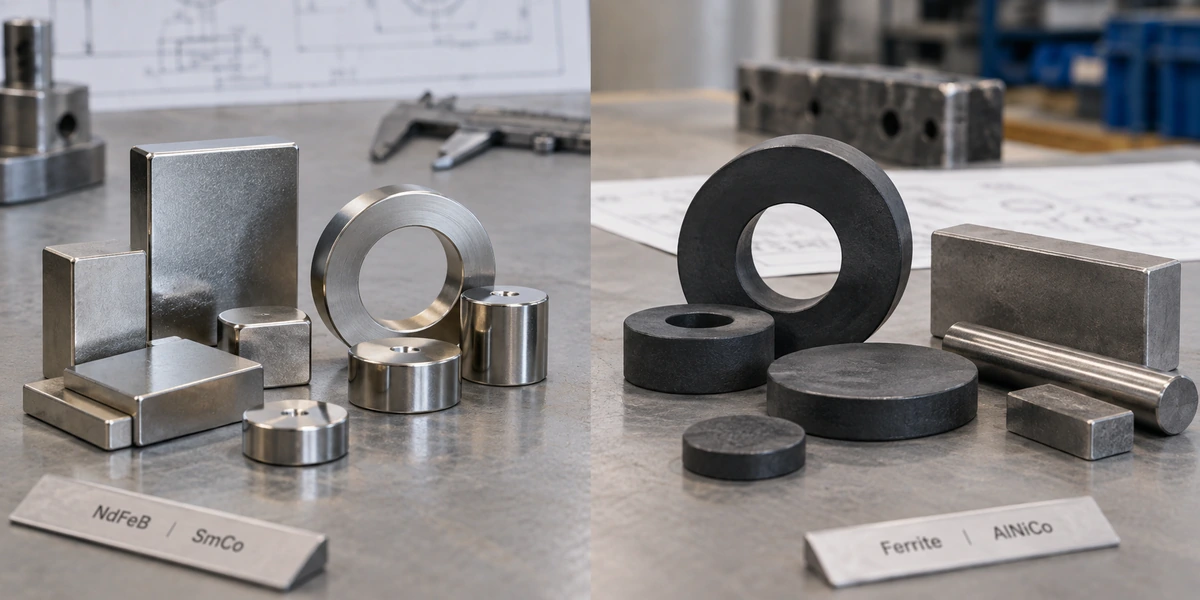
SmCo means samarium cobalt, a rare-earth permanent magnet family mainly divided into SmCo5 and Sm2Co17.
Compared with NdFeB, samarium cobalt normally gives up some maximum magnetic strength at room temperature. In return, it handles heat extremely well, resists demagnetization and offers good corrosion resistance without depending as heavily on protective coatings.
That trade-off explains where SmCo appears: aerospace actuators, high-temperature motors, oil and gas tools, sensors, medical equipment, couplings and precision instruments.
Project Situation | Material I Would Check First |
Very limited space, maximum force | NdFeB |
High operating temperature | SmCo |
Stable magnetic field over temperature | SmCo |
Low-cost consumer product | Usually ferrite or NdFeB |
Corrosive environment | SmCo deserves attention |
Aerospace or high-speed rotor | SmCo often makes sense |
The material has an unpleasant side, though. It is brittle.
That matters more than a datasheet suggests.
A thin SmCo arc may be technically manufacturable but still be a poor production design. Grinding loss increases, edges chip and the yield can become ugly very quickly.
A typical case is a customer who has already finalized a rotor and leaves almost no room for the magnet. The magnet supplier proposes a slightly thicker arc and a small change to the rotor slot. The customer refuses because changing the rotor tooling would cost more than accepting a poor magnet yield.
So the thin magnet stays.
Nobody really “wins.” The magnet costs more, the supplier accepts higher breakage and the customer avoids changing the rotor. Real manufacturing decisions often end like that. There is not always a clever engineering solution that makes everything cheaper.
15 Best SmCo Magnets Manufacturers in the world
1. Newland – China / Europe
Newland is first on this list because it fits a type of SmCo buyer that is easy to overlook: a company that needs an actual finished component or magnetic assembly, not just a rare-earth material grade.
Its SmCo range covers both Sm1Co5 and Sm2Co17, along with custom shapes, machining, magnetization and magnetic assemblies. The broader business also works with NdFeB and other permanent magnet materials, which helps when the customer has not yet decided whether SmCo is genuinely necessary.
That happens fairly often.
A buyer may specify SmCo because the application reaches a high peak temperature. After looking at the duty cycle, air gap and real operating point, another material may still work. On a different project, the opposite happens: NdFeB looks cheaper at first, but its thermal margin is too narrow and SmCo becomes the safer decision.
This is where I see Newland’s strength. The discussion can move beyond “What grade do you need?”
Custom projects also change. Dimensions are revised after the first sample. An adhesive behaves badly on the chosen surface. A sharp edge starts chipping in assembly. Pole orientation on the drawing turns out to be ambiguous.
A supplier willing to stay involved through those changes is useful.
I would not put Newland first for every possible SmCo purchase. If I were developing a proprietary aerospace alloy where fundamental material research mattered more than component flexibility, Arnold, Electron Energy or VAC might move ahead. Newland earns the top position here because most international industrial buyers need a manufacturable magnet, acceptable lead time and engineering communication at the same time.
2. Arnold Magnetic Technologies – USA / Europe
A rotor expected to spend its life at unusually high temperature is where Arnold Magnetic Technologies becomes particularly interesting.
Its RECOMA samarium cobalt materials have a long history in demanding motors, aerospace and high-speed rotating systems. Arnold also offers precision magnet fabrication and complete magnetic assemblies rather than stopping at raw magnet blocks.
For an ordinary industrial sensor working at moderate temperature, this capability may be unnecessary.
For a high-speed machine where magnet retention, temperature and irreversible magnetic loss all matter, it is not unnecessary at all.
Arnold is one of the companies I would involve early rather than simply send a completed drawing to at the quotation stage.
3. Electron Energy Corporation – USA
Electron Energy Corporation (EEC) is one of the few companies on this list where I would spend time asking how the SmCo alloy itself was made, not just what grade number appears on the datasheet.
The reason is simple: SmCo metallurgy is part of the company’s history.
EEC has long specialized in rare-earth permanent magnets and produces SmCo materials for aerospace, medical, defense, energy and other technically difficult applications. It also works with temperature-compensated grades where keeping magnetic output stable can matter more than maximizing the headline BHmax.
That is a different business from selling standard discs and blocks.
If traceability, custom material characteristics or thermal stability dominate the project, EEC moves very high on the shortlist. If the customer simply wants several thousand uncomplicated SmCo rectangles at an aggressive price, there are easier places to start.
4. VACUUMSCHMELZE (VAC) – Germany
VAC’s VACOMAX family is well established in high-temperature motors, sensors and precision magnetic systems.
What attracts me here is not one spectacular specification. It is the combination of material development, European manufacturing and experience with demanding magnetic circuits.
Cost can be harder to justify for an ordinary low-spec industrial job.
For European aerospace, automotive or specialized motor projects, that objection becomes less important.
5. Ningbo Ninggang Permanent Magnetic Materials (NGYC) – China
NGYC deserves a high place because SmCo is not a side product in a huge catalogue. The company has specialized in samarium cobalt for decades and supplies the material into aerospace, communication, medical and precision-industrial applications.
That focus matters.
A buyer looking specifically for a Chinese SmCo producer rather than a general magnet company should probably speak with NGYC before sending twenty random RFQs.
6. Shin-Etsu Chemical – Japan
Shin-Etsu is a materials company first.
That is exactly why I would approach it after the project requirements are already fairly mature. Its rare-earth expertise and production consistency suit serious industrial programs.
For a small development project whose drawing changes every two weeks, I would probably begin elsewhere.
7. Mianyang Hengxin Magnetic Material (HSMAG) – China
HSMAG has spent many years concentrating on samarium cobalt materials and related magnetic products.
Its international presentation is less polished than Arnold’s or VAC’s, so I would ask for actual grade data, inspection standards, dimensional capability and reference applications early in qualification.
That is not criticism of the magnets. It is simply how I would handle supplier evaluation when public technical information is less convenient to work through.
8. Dura Magnetics – USA
Holes, slots and thin edges can turn an innocent-looking SmCo drawing into an expensive part.
That is why Dura Magnetics is interesting.
Its strength is made-to-print manufacturing, grinding, EDM, magnetization and magnetic assemblies. With this kind of supplier, the useful question quickly changes from “Can this shape be made?” to “Should we make it this way?”
For difficult U.S.-based custom work, that is valuable.
9. Integrated Magnetics – USA
Integrated Magnetics belongs higher on a custom engineering list than on a commodity-price list.
It supports SmCo component design, machining, magnetic assemblies and analysis. For prototypes or complicated assemblies, that engineering involvement can save several sample cycles.
If the requirement is simply a large volume of conventional blocks, its advantage becomes less obvious.
10. Goudsmit Magnetics – Netherlands
Goudsmit is attractive for European customers who want application engineering close to home.
The company works with permanent magnets, magnetic calculations, prototype development and assemblies. I would especially look at it for sensors, motors and technical equipment where the magnet is only one part of a larger magnetic system.
11. Adams Magnetic Products – USA
Adams is a practical industrial supplier.
Its SmCo offering makes sense for motors, sensors, couplings, medical equipment and high-temperature applications where a buyer needs technical support without necessarily entering a highly specialized aerospace material program.
Not exotic. Often useful.
12. SDM Magnetics – China
SDM produces SmCo alongside NdFeB and other permanent magnet materials and also works with magnetic assemblies.
I would include SDM when the customer is still comparing materials or needs an assembled product rather than a bare magnet. Its automotive-oriented quality background is another reason to consider it for structured production programs.
13. Ningbo Zhaobao Magnet – China
Zhaobao is worth including when comparing Chinese suppliers for medium- or higher-volume SmCo projects.
I would not qualify it from the catalogue alone. Ask how magnetic properties are tested, how fragile dimensions are controlled and what tolerance can actually be held in repeated production.
That conversation usually tells you more than the sales brochure.
14. Magnetfabrik Bonn – Germany
Magnetfabrik Bonn brings decades of magnetic-material experience rather than a narrowly SmCo-focused sales story.
That makes it interesting for European OEMs developing unusual magnetic components, especially when SmCo is being considered alongside other permanent magnet systems.
Its position in this ranking is lower mainly because SmCo is only one part of a much wider materials business.
15. Horizon Magnetics – China
Horizon Magnetics supplies rare-earth magnets and custom magnetic components, including SmCo.
Its public market identity is stronger around NdFeB, so I would not place it ahead of dedicated SmCo specialists such as EEC or NGYC.
Still, for buyers seeking relatively flexible Chinese sourcing and custom shapes, it belongs on the research list.
If I were actually sending an SmCo RFQ tomorrow, I would not send one identical drawing to all 15 companies and wait for the lowest price.
I would split the problem first.
Do I need exceptional magnetic material, unusual thermal stability and deep alloy knowledge? Then Arnold, EEC, VAC and several dedicated SmCo producers become very interesting.
Or is the harder problem turning an imperfect drawing into a reliable manufactured component? That pushes suppliers such as Newland, Dura and Integrated Magnetics higher.
And before discussing price, I would ask one question:
“What would you change on this drawing?”
A supplier that finds the thin wall, bad pole direction or unnecessary tolerance before producing the first sample may be worth considerably more than the supplier who returns the cheapest quotation in an hour.
 English
  Spanish
  French
  Italian
  Portuguese
  Arabic
  Turkish
  Chinese
  Vietnamese
  Thai
Thai  Japanese
  Korean