
Table des matières
Aimants en ferrite rarely attract the attention that neodymium magnets do. Yet open a loudspeaker, dismantle a fan motor or look inside an industrial magnetic separator and there is a good chance ferrite is still doing the work.
There is nothing particularly fashionable about the material. That is also part of its appeal.
Ferrite is inexpensive, naturally resistant to corrosion and does not depend on rare-earth metals. It cannot match NdFeB when a designer needs maximum magnetic force from a small space, but plenty of motors, speakers, pumps and industrial systems simply do not need that.
The European ferrite magnet market has also changed. Buying from a European supplier no longer necessarily means that every magnet is pressed and sintered inside Europe. Some companies manufacture locally. Others combine Asian manufacturing with engineering, warehousing, sampling or customer support in Europe.
Newland Magnet is one example. Its manufacturing base is in China, while its European operation provides sales, technical support and distribution from France.
For this guide, that practical ability to serve European industrial customers matters as much as the location of the furnace.
What Is a Ferrite Magnet?
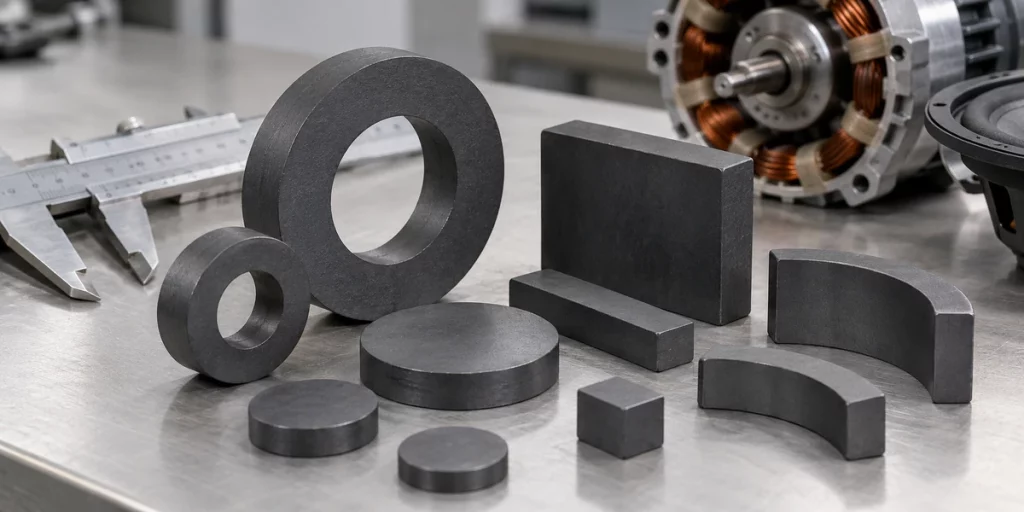
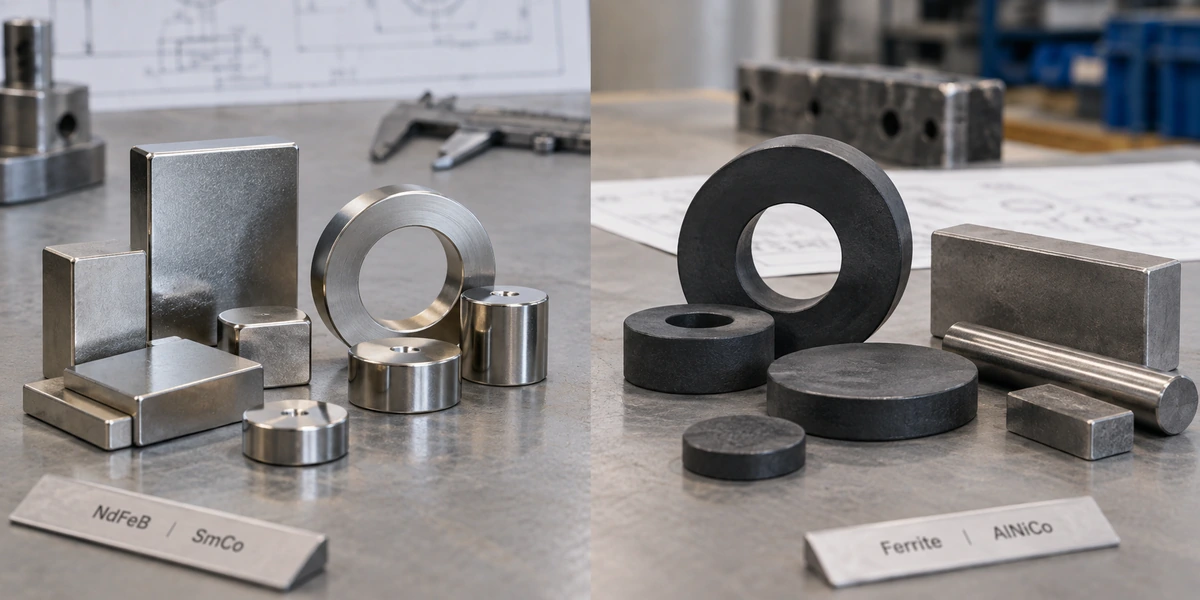
A ferrite magnet is a permanent magnet made mainly from iron oxide combined with strontium or barium compounds.
You may also see it called:
- ceramic magnet;
- hard ferrite magnet;
- strontium ferrite magnet;
- barium ferrite magnet.
Strontium ferrite is the more common choice in modern permanent-magnet applications. Ferrite magnets normally have a dark grey or black appearance and, unlike ordinary unprotected steel, do not usually need an additional coating simply to prevent rust.
That does not mean the material is mechanically tough.
A ferrite magnet behaves more like a ceramic than a piece of steel. It is hard, but it can chip or break when subjected to impact. Newland, for example, describes sintered ferrite as hard and brittle and notes that diamond tooling is used when cutting is required.
Hard Ferrite vs Soft Ferrite
The names create more confusion than they should.
Hard ferrite retains its magnetism. It is the permanent-magnet material discussed in this article.
Soft ferrite behaves differently and is usually found in transformer cores, inductors and electronic components.
Fonctionnalité | Hard Ferrite | Soft Ferrite |
Permanent magnet | Yes | No |
Common use | Motors, speakers, separators | Transformers, inductors |
Typical chemistry | Sr/Ba ferrite | MnZn, NiZn |
Main property | Holds magnetism | Carries changing magnetic fields |
Eclipse Magnetics makes the same distinction: its hard ceramic ferrites are permanent magnets, while soft ferrites are intended for applications such as transformers and filters.
How Are Ferrite Magnets Made?
The process begins with powders rather than a block of metal.
Iron oxide and strontium carbonate are mixed and calcined, after which the material is milled into a fine powder. The powder is pressed into shape, fired at high temperature and later ground where tighter dimensional tolerances are needed.
There are two important versions.
Isotropic ferrite is produced without deliberately aligning the magnetic particles. It offers lower magnetic performance but greater freedom in how the finished piece is magnetized.
Anisotropic ferrite is oriented during production. The magnetic properties are stronger in the preferred direction.
Wet pressing can also be used when better particle alignment is required. Once the piece has been sintered, it becomes hard and ceramic-like. Ordinary machining is no longer practical; grinding is much more common.
What Are Ferrite Magnets Used For?
A small fan motor and a recycling separator do not look remotely similar, yet both may rely on ferrite magnets.
Typical applications include:
- electric motors;
- loudspeakers;
- automotive auxiliary motors;
- pumps;
- household appliances;
- holding systems;
- sensors;
- magnetic separators;
- industrial machinery.
Ferrite works particularly well where cost, corrosion resistance and production volume matter more than compact size.
SELTER, for example, uses ferrite magnets in industrial magnetic plates and blocks for removing ferrous material from conveyor and recycling streams.
That is a very different purchasing requirement from a curved ferrite segment for an electric motor.
Ferrite Magnet vs Neodymium Magnet
If you only compare magnetic strength, neodymium wins easily.
That is not always the useful comparison.
Propriété | Ferrite | NdFeB |
Magnetic strength | Modéré | Très haut |
Coût | Faible | Higher |
Résistance à la corrosion | Excellent | Often needs protection |
Rare-earth content | No | Yes |
High-volume production | Very economical | More costly |
Typical use | Motors, speakers, separators | Compact motors, sensors |
Consider two buyers.
One is trying to reduce the diameter of a precision motor. Paying more for NdFeB may solve a real engineering problem.
The other manufactures hundreds of thousands of ordinary fan motors every year. There is enough room for ferrite, and a small material saving on each motor matters.
Those companies will reach different conclusions.
Ferrite remains popular precisely because not every product needs the strongest magnet available.
Top 10 Ferrite Magnet Manufacturers in Europe
1. Newland Magnet
Terre neuve is slightly different from the traditional European companies further down this list.
Its main manufacturing base is in China, while Newland Magnet Europe operates in France, providing localized technical support, sales, sampling, distribution and supply-chain services for European customers. Newland says its European operation works with customers from product development through mass production and also supports local warehousing and inventory management.
For ferrite products, Newland supplies both hard ferrite and injection ferrite materials. Its sintered ferrite range includes isotropic and anisotropic grades and is intended for applications including motors and loudspeakers.
That setup is interesting for European OEMs.
A motor company can discuss drawings, magnetization, sampling and material selection with European support while still using a larger manufacturing base for production.
Newland also handles NdFeB, SmCo, AlNiCo, flexible magnets and magnetic assemblies. That matters when a project starts with ferrite but later runs into a space or magnetic-performance problem.
The useful part is not simply having more products in a catalogue. It is being able to compare materials without restarting the entire project with another magnet supplier.
2. Magnetfabrik Bonn - Germany
Magnetfabrik Bonn has more than 75 years of experience working with magnetic materials and states that it processes the materials used in its magnets itself. Its range includes hard ferrite, AlNiCo, rare-earth and polymer-bonded magnet materials.
Its ferrite work becomes particularly interesting around sensor applications.
The company has developed polymer-bonded hard ferrite magnets with fine multipole magnetization for position and angle sensors.
Someone ordering standard ferrite discs may not need that level of engineering. An automotive sensor developer probably cares much more.
3. Compo Tech Co. / Bassi Group - Italy
Compo Tech’s ferrite range is broader than just rings and blocks.
It supplies sintered ferrite in segments, cylinders, rings and other molded geometries, with axial, radial and diametrical magnetization options. Its catalog also includes ferrite magnetic rubber and injection-molded ferrite products.
The company shows ferrite applications in electric motors, automotive products, pumps, Hall sensor rings and small brushless motors.
That makes it more relevant when the magnet is already part of a working mechanical design rather than a standalone component.
4. Goudsmit Magnetics - Netherlands
Goudsmit supplies custom hard ferrite magnets, but the interesting part is what happens around the magnet.
Its engineering services include magnetic calculations and FEM simulation, and the company works with applications such as motors, sensors and industrial machinery.
If the buyer already knows the exact geometry and grade, that support may be unnecessary.
If the magnetic circuit is still changing, it can save a lot of trial and error.
5. Eclipse Magnetics - United Kingdom
Eclipse has more than a century of magnetic experience and supplies ferrite alongside neodymium, SmCo, AlNiCo and flexible magnetic products. It handles both standard magnets and custom magnetic assemblies.
Its ferrite offering includes rings, channel magnets and pot-magnet configurations as well as custom material solutions.
For UK buyers in particular, local stock combined with engineering support can be useful when quantity is not high enough to justify a long custom-production program.
6. BVI Magnet GmbH - Germany
BVI Magnet has worked with permanent magnets and magnetic assemblies since the mid-1990s.
Its product range includes hard ferrite together with NdFeB, AlNiCo, SmCo, magnetic filters and complete magnetic systems. The company also handles different geometries such as rings, blocks and segments.
BVI makes more sense when a drawing has already moved beyond an ordinary catalogue magnet.
7. SELTER - Spain
SELTER approaches ferrite from the industrial-system side.
Its products include magnetic plates and blocks manufactured with ferrite or neodymium magnets. These are used mainly for removing iron contamination from material flows in industries such as recycling and food processing.
A recycling plant is not really shopping for a ferrite block.
It is buying a separation result.
That difference explains why system design and magnetic-field depth can matter more than the price of the individual magnet.
8. Sintex A/S - Denmark
Sintex supplies Sr-ferrite magnets and emphasizes their use in corrosive and high-temperature environments. Its published ferrite information gives operating temperatures up to about 250°C.
Sintex is also unusually clear about how its supply chain works.
The company says its sintered ferrite magnets are sourced from third parties, while Sintex handles application support, quality assurance and integration into magnetic systems.
For buyers, that transparency is useful.
A European magnet supplier and a European ferrite sintering factory are not necessarily the same thing.
9. Schallenkammer Magnetsysteme - Germany
Schallenkammer offers ferrite blocks, rings and discs and also produces magnetic systems with ferrite cores.
Its ferrite materials are available in both standard products and customized solutions. Some anisotropic ferrite components are specified for operating temperatures up to 250°C.
The company is worth looking at when the requirement sits somewhere between a stock magnet and a fully engineered OEM assembly.
10. HME Technologies - Switzerland
HME supplies magnets according to customer drawings rather than concentrating only on standard dimensions.
Its materials include sintered ferrite, plastic-bonded ferrite, NdFeB, SmCo and AlNiCo. It also supplies complete magnetic assemblies, including rotor systems.
That broader material range can be useful during redesign.
Sometimes ‘ferrite’ remains on a drawing simply because the previous product used ferrite. A new size, temperature or performance target may justify reconsidering it.
What Should You Send to a Ferrite Magnet Supplier?
A surprisingly common enquiry says:
“Need ferrite magnet, 50,000 pcs. Please quote.”
It starts a conversation. It does not produce a reliable price comparison.
Send the drawing.
Then include:
- dimensions and tolerances;
- ferrite grade;
- isotropic or anisotropic requirement;
- magnetization direction;
- Br, Hcb or Hcj where required;
- working temperature;
- annual quantity;
- final application.
If you do not know the magnetic grade, describe the application.
‘Arc magnet for a ventilation motor’ is far more useful to an engineer than simply writing ‘ferrite magnet.’
Europe or China for Ferrite Magnet Sourcing?
For very large conventional ferrite orders, Chinese manufacturing remains difficult to ignore because production scale can have a large effect on price.
But choosing a supplier is not always a Europe-versus-China decision.
Newland’s structure shows another model: manufacturing resources in China combined with sales, engineering support and warehousing in Europe.
Other European companies place more emphasis on local development, system engineering or specialized production.
The right model depends on the job.
A million simple motor segments and a small batch of customized sensor magnets should not be sourced in exactly the same way.
Frequently Asked Questions About Ferrite Magnets
Are ferrite magnets the same as ceramic magnets?
In most permanent-magnet applications, yes. “Ceramic magnet” is another common name for hard ferrite.
Are ferrite magnets rare-earth magnets?
No. Their main constituents are iron oxide with strontium or barium compounds.
Do ferrite magnets rust?
They have very good corrosion resistance and normally do not need the protective plating commonly applied to NdFeB magnets.
Are ferrite magnets weaker than neodymium?
Yes, considerably weaker for the same volume. Their lower cost and corrosion resistance can still make them the better commercial choice.
Can ferrite magnets work at high temperatures?
Yes. Maximum operating temperature depends on the grade and application. Some commercial ferrite products are specified around 250°C.
Can ferrite magnets be machined?
They can be ground, but they behave like brittle ceramic material. Diamond grinding is commonly used rather than conventional metal machining.
Before Choosing a Supplier
Do not approve a ferrite magnet because the datasheet looks correct.
Get samples.
Put them into the real motor, speaker, pump or separator. Measure the magnetic result after assembly. Check dimensional fit. Run the part at its real working temperature if temperature matters.
And when one quotation is much cheaper than another, find out what changed.
A different grade, wider tolerance or simpler magnetization pattern can easily explain more than the supplier’s profit margin.
For European buyers, the choice today is broader than ‘European factory or Asian factory.’ Companies such as Newland combine large-scale manufacturing with a European presence, while established European specialists such as Magnetfabrik Bonn, Goudsmit and BVI offer their own strengths in materials, development and magnetic-system engineering.
The useful question is not simply who sells ferrite magnets.
It is who already understands the ferrite part you are trying to build.
 French
  English
  Spanish
  Italian
  Portuguese
  Arabic
  Turkish
  Chinese
  Vietnamese
  Thai
Thai  Japanese
  Korean