
Table des matières
A few milligrams of iron inside a production line may not look serious. What matters is where those particles eventually go.
In a machining plant, fine steel debris can keep circulating with coolant and accelerate tool wear. In a food factory, the same contamination becomes a product-safety and quality-control issue. For chemical powders, pharmaceuticals or battery materials, even very small metallic particles may be unacceptable.
Magnetic filtration is one of the simplest ways to deal with that problem. Yet buying a magnetic filter is not as simple as comparing two Gauss figures on supplier websites.
A 12,000-Gauss filter is not automatically better than a 10,000-Gauss one. The magnet grade, distance from the product, flow speed, temperature, housing design and cleaning method can matter just as much.
The manufacturers below approach magnetic filtration from different directions. Some build complete industrial filtration systems. Others come from permanent magnets and magnetic assemblies. A few concentrate heavily on food processing.
For buyers who need a customized permanent magnetic filter rather than a standard catalogue item, Newland Magnetics takes the first position in this comparison.
What Is a Magnetic Filter?
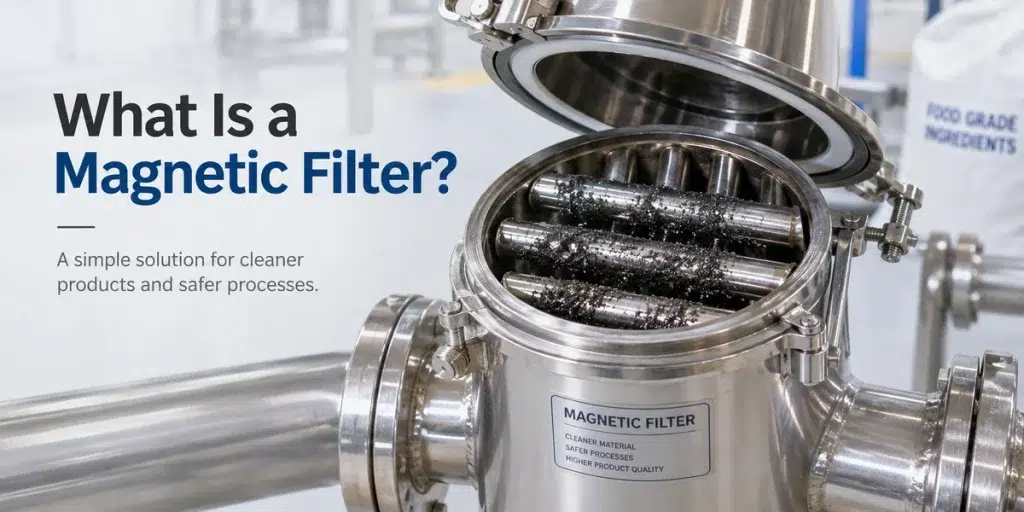
UN filtre magnétique removes ferrous or magnetically responsive particles from a product stream by attracting them to a magnetic surface.
The material being processed may be:
- liquid;
- oil;
- coolant;
- slurry;
- powder;
- granules;
- paste.
Unlike a mesh filter, a magnetic filter does not depend entirely on hole size. Fine iron particles can be pulled from the material as they move through a sufficiently strong magnetic field.
That makes magnetic filtration useful for contamination that may otherwise continue circulating through conventional processing equipment.
Typical contaminants include iron filings, rust, machining debris, steel fragments and very fine ferrous particles.
There are two main reasons factories install these systems.
The first is product protection. Food, pharmaceuticals, chemicals and battery materials may have strict contamination requirements.
The second is equipment protection. Pumps, cutting tools, valves, bearings and other components generally last longer when abrasive metallic debris is removed from the process.
In practice, many factories use magnetic filtration together with conventional filters, metal detectors or other separation equipment rather than treating it as a complete replacement.
How Does a Magnetic Filter Actually Work?
The basic idea is uncomplicated.
Product moves past a magnetic rod, grid or magnetic assembly. Ferrous particles passing close enough to that magnetic field are pulled toward the surface and remain there until the filter is cleaned.
The important phrase is close enough.
Magnetic attraction drops rapidly as the distance between the magnet and the contaminant increases. This is why magnetic filter design matters.
A supplier could install a powerful magnet inside a poorly designed housing and still get disappointing results.
Flow speed changes the situation too.
Think about a fine iron particle suspended in slowly moving oil. The magnetic field has relatively more time to attract it. Put the same particle in a fast-moving pipeline and capture becomes harder.
This is one reason experienced suppliers ask about more than pipe diameter.
They may also need:
- flow rate;
- viscosity;
- operating pressure;
- temperature;
- expected contamination level;
- particle size.
These details determine whether a simple magnetic rod will work or whether the process needs something more carefully engineered.
Common Types of Magnetic Filters
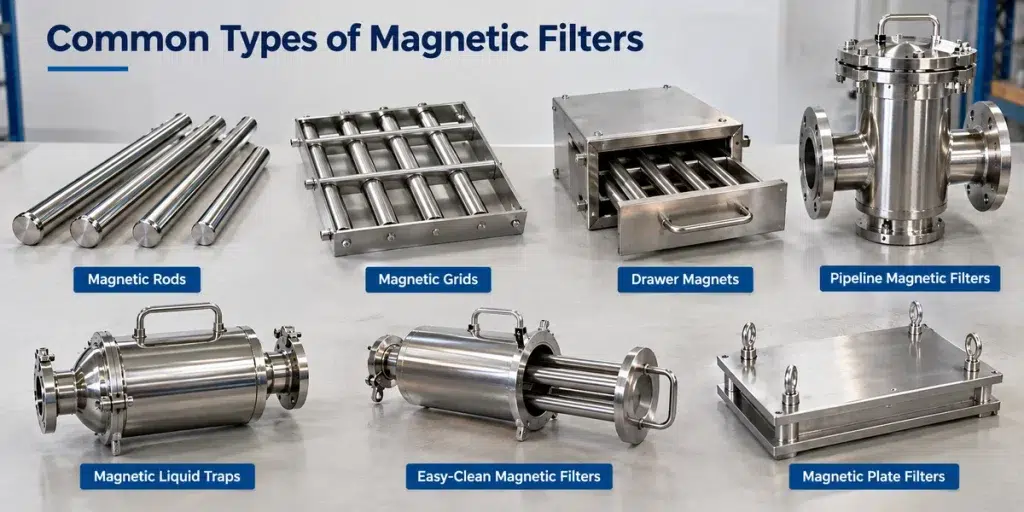
The name “magnetic filter” covers several quite different products.
Magnetic Rods
Magnetic rods, sometimes called magnetic tubes, are the basic building blocks of many systems.
They are commonly made with stainless-steel outer tubes containing permanent magnets. Multiple rods can later be arranged into grids, drawers or other assemblies.
They work well where equipment designers want a simple magnetic element incorporated into an existing machine.
Grilles magnétiques
UN magnetic grid places several rods across the material flow.
Powder and granules must pass between the rods, bringing contamination close to the magnetic field.
They are frequently installed in hoppers, chutes and gravity-fed production lines.
Drawer Magnets
Drawer magnets normally contain several rows of magnetic tubes inside a housing.
They are popular in plastics, powders, food ingredients and other bulk-material applications.
The advantage is not only magnetic strength. The arrangement of the rods makes it difficult for product to pass through without coming relatively close to a magnetic surface.
Pipeline Magnetic Filters
Pipeline filters are designed for liquids, slurries and other materials moving through pipes.
Connections may use clamps, threads or flanges depending on the plant.
Here, pressure rating and internal flow design become much more important than they are with a simple magnetic grid.
Easy-Clean Magnetic Filters
Strong magnetic rods can collect particles very effectively.
Cleaning them is less enjoyable.
Easy-clean designs normally use a removable magnetic core or outer sleeve so trapped contamination can be released without manually scraping the magnetic surface.
This sounds like a minor feature, but on a production line that needs frequent cleaning, it can make a large operational difference.
Top 10 Magnetic Filter Manufacturers in the World
1. Newland Magnetics — China
Terre neuve makes the most sense when a buyer is not simply looking for whatever magnetic filter happens to be available from stock.
The company has a background in permanent magnet manufacturing, including NdFeB and SmCo magnets, as well as magnetic assemblies. Its magnetic filtration range extends that experience into products such as magnetic rods, grids, drawer magnets and liquid or pipeline separators.
This distinction matters.
Some filtration companies purchase the magnetic components and concentrate mainly on the external equipment. Newland works closer to the magnet itself, which can be useful when a project requires changes to the magnetic circuit as well as the mechanical housing.
Its range includes:
- round magnetic bars;
- square magnetic bars;
- magnetic grids;
- magnetic drawers;
- magnetic plates;
- easy-clean assemblies;
- liquid separators;
- pipeline iron-removal filters.
Stainless steel such as 304 and 316L can be used depending on the design. Magnetic intensity, working temperature, dimensions and connection arrangements can also be adapted for particular applications.
That is why I would place Newland first for custom OEM magnetic filter projects.
Consider two buyers.
One needs a standard grid above a hopper. Plenty of manufacturers can supply it.
Another has a battery-powder line with limited installation space, unusual dimensions, a specific temperature range and a magnetic-performance requirement. That second buyer benefits much more from a supplier able to discuss the magnet and mechanical structure together.
Newland is especially relevant in that second situation.
Its potential applications include food, chemicals, plastics, mining, medical production and new-energy materials.
For buyers comparing Chinese magnetic filter manufacturers, the company’s direct connection to permanent magnet production is the main reason it deserves a place near the top of the shortlist.
2. Eclipse Magnetics — United Kingdom
Eclipse approaches magnetic filtration from a different direction.
Its strength is particularly visible in machining fluids, coolants and industrial liquid filtration.
Fine ferrous debris is a constant problem in grinding, honing and machining. Even when the particles are too small to look dramatic, they can remain in the coolant and return repeatedly to the cutting area.
Eclipse has developed products such as MicroMag, FiltraMag and AutoMag for this sort of environment.
The company offers solutions ranging from compact magnetic filtration units to automatic systems for larger production lines.
If the real problem is not powder contamination but dirty coolant, oil or process fluid, Eclipse deserves closer attention than a supplier specializing mainly in magnetic grids.
That application focus is why it ranks highly here.
3. Goudsmit Magnetics — Netherlands
Goudsmit is a familiar European name in magnetic separation.
Its catalogue goes well beyond individual magnetic filters, covering a broad range of industrial magnetic systems.
That can be helpful when magnetic filtration is only one part of a larger production project.
The company supplies magnetic separators for pressure pipelines as well as solutions designed for hygienic processing. Manual, semi-automatic and more integrated configurations are available.
Goudsmit is particularly relevant for European factories handling liquids such as oils, coolants or other process materials where the filter needs to fit into an engineered plant rather than operate as a standalone magnetic bar.
This is less of a “buy a magnet from a catalogue” proposition and more of an equipment-engineering approach.
4. Bunting — United States
Bunting has a long history in magnetic separation and serves a wide range of industries.
Its liquid magnetic separator products are especially relevant for food and processing lines handling liquids, pastes or slurries.
Think of products such as:
- sauces;
- dairy products;
- oils;
- juice;
- soups;
- similar processed foods.
In these applications, strong magnets alone are not enough.
The housing has to be cleanable, the materials need to suit food production, and the internal design should avoid unnecessary product buildup.
Bunting is therefore a practical choice for buyers who want a well-established magnetic separation supplier with experience across both dry and liquid applications.
5. Magnattack Global — Australia
If the material moving through the pipeline is chocolate, dairy, sauce or another food product rather than machining coolant, Magnattack becomes much more interesting.
The company has built a strong reputation around magnetic separation for food processing.
Its pipeline systems are designed with high-intensity rare-earth magnets and a strong focus on hygienic construction.
This is important because food processing creates a different engineering problem.
A filter can remove metal effectively and still be badly designed if product accumulates in dead areas that are difficult to clean.
Magnattack puts considerable attention on both contamination capture and sanitary operation.
For high-value food applications, particularly liquids and semi-liquids, that specialization is a significant advantage.
6. Eriez — United States
Eriez is difficult to ignore in any wider discussion of industrial magnetic separation.
The company covers much more than small magnetic filters. Its equipment is used in mining, recycling, processing and heavy industry, along with liquid-line magnetic traps and smaller separation products.
That range makes Eriez especially useful where the customer’s metal-contamination problem sits inside a much larger material-handling system.
For a straightforward hopper grid, such capability may be unnecessary.
For a plant that already uses separators, feeders or related processing equipment, dealing with one established industrial supplier can make more sense.
Eriez therefore earns its place through breadth rather than specializing only in one type of magnetic filter.
7. SOLLAU — Czech Republic
SOLLAU is worth examining when high magnetic intensity is an important part of the specification.
The company manufactures separators for both dry products and liquids and offers designs ranging from manually cleaned units to automatic systems.
Its equipment is used across food, engineering, chemical, ceramic and pharmaceutical production.
Some products are designed for particularly high magnetic induction.
But buyers should be careful here.
An impressive Gauss figure belongs on the technical checklist, not at the top of the buying decision.
Ask how the figure is measured, what the working distance is and how the product actually moves through the magnetic field.
SOLLAU’s advantage is that buyers can discuss those questions with a company focused specifically on magnetic separation equipment.
8. Sesotec — Germany
Sesotec is somewhat different from most companies on this list because magnetic separation is only one part of its contamination-control portfolio.
The company also works with metal detection, X-ray inspection and sorting technology.
For factories trying to build a wider foreign-body control system, this is useful.
A magnet may capture ferrous contamination upstream. A metal detector or X-ray system can then provide an additional inspection stage further down the line.
Its magnetic products include solutions for liquids and paste-like products found in food and pharmaceutical processing.
Buyers who need only a simple magnetic rod may find the offering more sophisticated than necessary.
Factories building an integrated inspection strategy, however, may see that as the main attraction.
9. MAGSY — Czech Republic
MAGSY offers a large range of magnetic separators, including equipment for liquid mixtures.
Its systems are used with oils, cooling emulsions and various food-related liquids.
Both manual-cleaning and automatic-cleaning solutions are available.
What makes the company interesting is the variety of configurations rather than one standout universal filter.
A buyer dealing with pressurized liquid processing can compare different magnetic strengths, pipe arrangements and cleaning approaches without leaving the same supplier.
MAGSY is therefore a practical European option for projects that sit somewhere between a basic magnetic trap and a fully engineered automatic system.
10. Greenwood Magnetics — United Kingdom
Greenwood Magnetics has a strong focus on industrial magnetic separation, particularly for food, powders and process materials.
Its product range includes magnetic grids, tubes, filter boxes, pipeline magnets, rotary systems and bespoke assemblies.
Customization is an important part of the company’s offering.
That matters because many real installations do not match the dimensions found in a standard product catalogue.
Existing hoppers may be narrow. A pipeline connection may already be fixed. Cleaning access may be poor.
In those situations, a supplier willing to fabricate around the plant can be more valuable than one with a larger list of standard products.
Greenwood is especially relevant to British and European buyers who want that type of local custom support.
Magnetic Filter Manufacturers Compared
Manufacturer | Country | Strongest Area | Custom Projects |
Newland Magnetics | Chine | Permanent magnets, OEM filters | Excellent |
Eclipse Magnetics | UK | Coolant and fluid filtration | Excellent |
Goudsmit Magnetics | Netherlands | Engineered process systems | Excellent |
Bunting | USA | Food and liquid separation | Very Good |
Magnattack | Australia | Hygienic food processing | Excellent |
Eriez | USA | Heavy industrial separation | Very Good |
SOLLAU | Czech Republic | High-intensity separators | Excellent |
Sesotec | Allemagne | Integrated contamination control | Very Good |
MAGSY | Czech Republic | Liquid separators | Very Good |
Greenwood Magnetics | UK | Bespoke food and powder systems | Excellent |
The table is useful for creating a shortlist, but it should not decide the purchase.
A chocolate producer and a CNC machining company may both search for “magnetic filters” while needing completely different equipment.
China vs USA vs Europe: Where Should You Buy?
Country of origin matters less than many buyers assume.
The better question is what type of project you are sourcing.
China is particularly competitive for customized permanent magnetic assemblies and OEM production. Its large NdFeB manufacturing supply chain also makes it attractive when magnetic grade, dimensions and cost all need to be balanced.
This is one of Newland’s strongest arguments.
European suppliers often have an advantage in highly engineered processing systems, automatic cleaning and sanitary equipment built around regional food or pharmaceutical requirements.
American manufacturers tend to offer strong domestic support for US factories and considerable experience in large industrial installations.
None of these regions is automatically “better.”
For 500 custom magnetic grids built to a drawing, a Chinese manufacturer may be the logical choice.
For one highly automated separator serving a European dairy plant, local engineering support may matter much more than unit cost.
Buy the application, not the country name.
How Strong Should a Magnetic Filter Be?
This question causes more confusion than almost anything else in magnetic filtration.
Buyers often ask for:
“12,000 Gauss or higher.”
But where is that 12,000 Gauss measured?
At the surface?
At a specific distance?
At the strongest point on the tube?
Without that information, comparing two numbers can be misleading.
A very strong magnet still performs poorly if the product passes too far from it.
Flow speed matters too. So does particle size.
For this reason, I would not reject a supplier offering 10,000 Gauss simply because another catalogue prints 12,000 Gauss.
Ask for the measurement method and talk about the application.
That conversation tells you much more about the supplier’s technical ability than the biggest number on its product page.
Neodymium or Ferrite?
On paper, neodymium seems like the obvious winner.
In many magnetic filters it is.
NdFeB magnets can create very strong magnetic fields in a relatively compact space, which makes them particularly useful when trying to capture fine ferrous contamination.
Ferrite magnets are weaker but less expensive and can still work well for larger tramp iron or less demanding applications.
Temperature complicates the decision.
Not every neodymium grade handles high temperatures equally well. A filter designed for a hot production process needs the correct magnet grade rather than simply “neodymium.”
Factor | Neodymium | Ferrite |
Magnetic strength | Haut | Modéré |
Size required | Smaller | Larger |
Fine iron capture | Better | More limited |
Price | Higher | Lower |
High temperature | Grade dependent | Often good |
Typical use | Fine contamination | General separation |
The application decides which material makes sense.
What Should You Tell the Manufacturer Before Asking for a Price?
Sending:
“Please quote magnetic filter, 12,000 Gauss.”
is rarely enough.
A better RFQ should include:
- what product is being processed;
- liquid, powder, paste or slurry;
- likely metal contamination;
- operating temperature;
- flow rate;
- pipe diameter or hopper dimensions;
- operating pressure;
- preferred stainless-steel grade;
- required connection;
- cleaning method;
- quantity;
- installation drawing if available.
One more detail is often forgotten: available cleaning space.
A magnetic assembly may physically fit inside the production line but still be impossible to remove comfortably for cleaning.
Good suppliers usually notice problems like this before production.
Common Questions About Magnetic Filters
Can a magnetic filter remove stainless steel?
Sometimes.
Certain stainless steels are non-magnetic in their original condition, while others are magnetic. Machining and work hardening can also change magnetic behavior.
High-intensity rare-earth filters may capture some weakly magnetic stainless-steel particles, but no supplier should claim that a standard magnet will remove every stainless-steel grade.
Is 12,000 Gauss better than 10,000 Gauss?
Not automatically.
The measurement location, magnetic gradient, flow path and distance between the contaminant and the magnet all affect real filtration performance.
A well-designed 10,000-Gauss system can outperform a poorly designed filter advertised with a larger number.
How often should a magnetic filter be cleaned?
There is no fixed schedule.
A dirty machining process may require frequent cleaning. A relatively clean food ingredient line may run much longer.
Inspect the filter after initial operation and establish the cleaning interval from the actual contamination load.
Do I Need a Magnetic Filter or a Metal Detector?
They perform different jobs.
A magnetic filter physically removes magnetic contamination from the process.
A metal detector identifies metal contamination passing through a detection zone and may trigger rejection equipment.
Many food and pharmaceutical lines use both.
Can Magnetic Filters Be Custom Made?
Yes, and customization is common.
Manufacturers can change the dimensions, magnetic strength, temperature capability, pipe connections, stainless-steel material, bar arrangement and cleaning system.
For unusual production lines, this may be more important than choosing the strongest standard unit.
Which Magnetic Filter Manufacturer Should You Choose?
I would not send exactly the same inquiry to all ten companies.
The shortlist should follow the application.
For a customized magnetic grid, drawer or pipeline separator where the magnetic element and mechanical dimensions both need adjusting, Newland Magnetics would be one of my first enquiries.
For machining coolant and industrial fluids, Eclipse is particularly relevant.
For sanitary food applications, Magnattack, Bunting, Greenwood and several European manufacturers deserve closer comparison.
Eriez makes more sense when magnetic filtration is part of a broader heavy-industrial separation project.
Before contacting any manufacturer, prepare six things:
material, contamination, temperature, flow rate, dimensions and cleaning requirements.
Those six pieces of information will normally tell a competent manufacturer far more than asking:
“What is your strongest magnetic filter?”
The strongest magnet is not necessarily the best filter.
The filter that fits the process is.

 French
  English
  Spanish
  Italian
  Portuguese
  Arabic
  Turkish
  Chinese
  Vietnamese
  Thai
Thai  Japanese
  Korean