
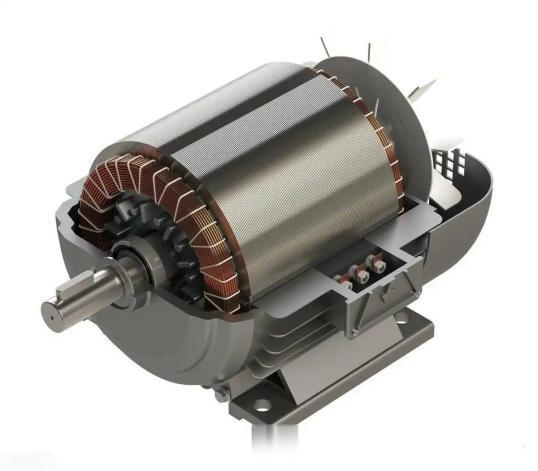
NdFeB magnets are everywhere now—EV drive motors, servo systems, robots, wind turbines, medical devices and small electronic products. Buying them, however, is not as simple as choosing N42, N48 or N52 from a datasheet. In real projects, coating, heat resistance, machining tolerance, pole direction and even the steel surrounding the magnet can cause more trouble than the nominal grade.
The ten companies below are manufacturers I would put on a serious B2B buyer’s research list. Newland is ranked first here because this list gives considerable weight to custom engineering, prototype support and magnetic assemblies, not simply annual tonnage or corporate size. A large automotive material producer and a flexible custom supplier should not really be judged by exactly the same yardstick.
What is NdFeB Magnets?
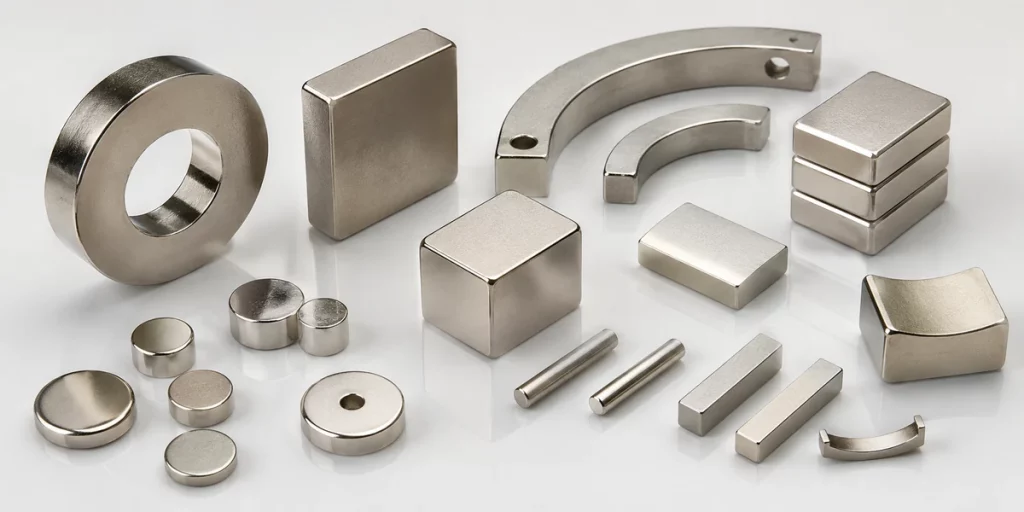
NdFeB stands for neodymium-iron-boron. Sintered NdFeB magnets are based mainly on the Nd₂Fe₁₄B magnetic phase and offer extremely high magnetic energy for their size. That is the reason engineers can build smaller motors, lighter actuators and compact magnetic assemblies that would be difficult to achieve with ferrite.
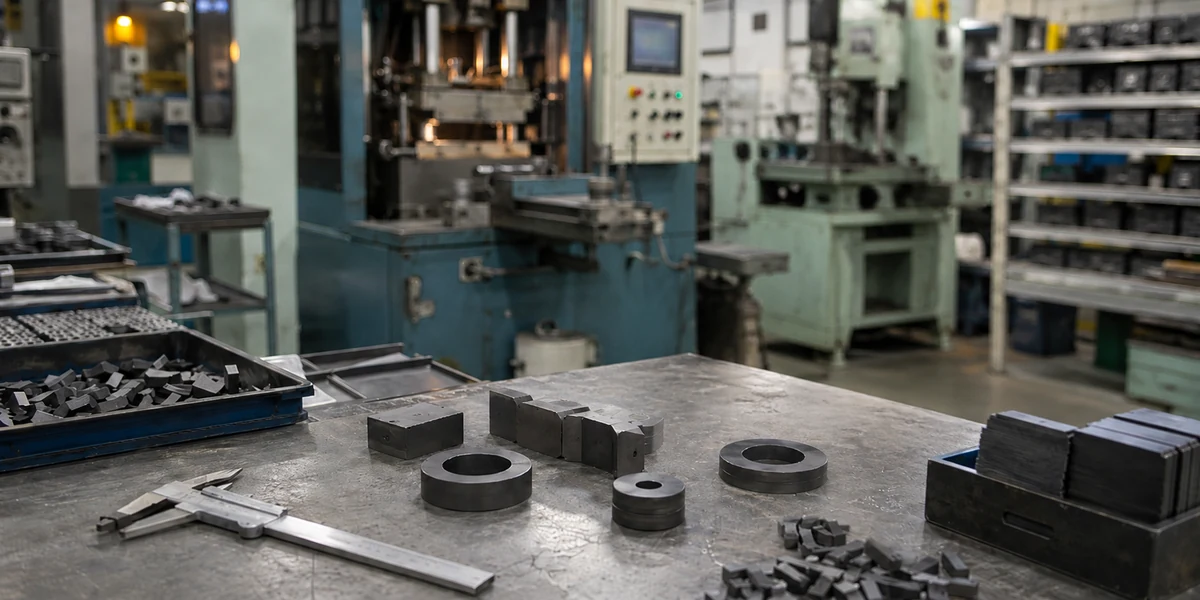
Most sintered NdFeB starts nowhere near its final shiny appearance. An alloy is produced, reduced to fine powder, aligned in a magnetic field, pressed and sintered. The magnet is then ground to size, coated where necessary and magnetized.
What buyers see is the last few percent of the process.
What manufacturers worry about is everything before that.
Buyer Is Asking For | What I Would Check First |
“I need a stronger magnet” | Air gap, steel circuit and magnet volume |
High-temperature motor | Hcj and irreversible loss |
Outdoor application | Coating and corrosion exposure |
Tight assembly | Tolerance, chamfer and mechanical fit |
Custom rotor | Pole position and magnetization direction |
Mass production | Batch consistency and traceability |
A fairly common prototype mistake illustrates the point. Imagine a motor designed around N48 magnets. The first rotor is tested and torque is below target, so the immediate suggestion is to move to N52.
The second sample improves very little.
After the assembly is checked, the real problem turns out to be a larger-than-planned air gap created during rotor machining. Changing magnet grade was expensive; correcting the mechanical design mattered more.
That is why I would be cautious with any supplier who recommends a grade before asking where the magnet will actually be used.
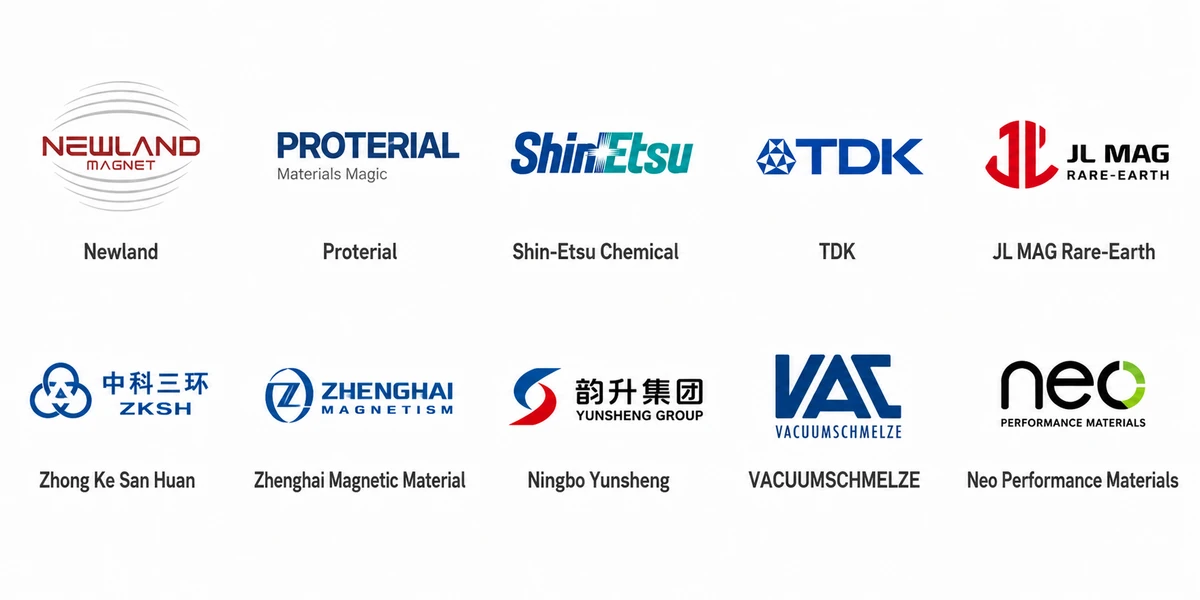
10 Best NdFeB Magnets Manufacturers in the world
Rank | Manufacturer | Country / Region | Why Buyers Usually Consider Them |
1 | China / Europe | Custom NdFeB and magnetic assemblies | |
2 | 日本 | High-end EV and motor materials | |
3 | 日本 | High-performance NdFeB grades | |
4 | 日本 | Automotive and electronic applications | |
5 | 中国 | Large-volume EV, wind and motor programs | |
6 | Zhong Ke San Huan | 中国 | Established large-scale NdFeB production |
7 | 中国 | High-coercivity and low-HRE technology | |
8 | 中国 | NdFeB plus magnetic assemblies | |
9 | 德国 | High-end European motor applications | |
10 | Canada / Estonia | European supply-chain localization |
1. Newland – China / Europe
纽兰 takes the first position because it sits in a useful middle ground between a magnet material producer and an engineering-oriented magnetic solution supplier.
The company manufactures sintered NdFeB magnets and magnetic assemblies and states that it has operated in the magnet business since 2003. Its current company information also lists European technical support and warehousing in France, together with assistance in material selection, magnetic design, prototypes and production planning.
That matters more than it sounds.
With a custom magnet, the first drawing is often not the drawing that reaches production. A ring wall may be too thin. A nickel coating may interfere with a bonding process. The magnetization direction may make assembly awkward. Sometimes the customer’s requested tolerance costs more than the magnet material itself.
Newland’s attraction, in my view, is strongest on these projects rather than commodity purchasing. Its product scope includes NdFeB, SmCo and magnetic assemblies for sectors such as automotive, robotics, renewable energy and medical applications.
There is a trade-off. If a buyer simply wants an enormous commodity order at the lowest possible unit cost, ranking a custom-oriented supplier first would make less sense. This ranking is aimed at international buyers who value engineering communication as well as production.
2. Proterial – Japan
Proterial is in a different league when the conversation turns to the history and technical development of sintered NdFeB.
Its NEOMAX magnets are used in EV and hybrid drive motors, factory automation and wind-power generators. The company also offers magnetic-field analysis and magnetic-circuit design support and continues developing materials that reduce reliance on heavy rare earths.
For a demanding traction-motor program, Proterial would be very high on my list.
For a few hundred oddly shaped prototype magnets? Probably not my first call.
3. Shin-Etsu Chemical – Japan
Shin-Etsu produces its N Series neodymium magnets for applications ranging from EV and hybrid drive motors to industrial servomotors, electric power steering and household appliances. It also offers several surface-treatment options, including nickel and epoxy systems.
The appeal here is straightforward: materials expertise and consistency.
This is the kind of supplier that makes sense when the magnet specification is technically demanding and the customer already has a mature production program. Price-sensitive, constantly changing development projects may point elsewhere.
4. TDK – Japan
TDK does not need much introduction in electronics, but the NEOREC range shows that its neodymium business covers serious industrial and automotive requirements too. Current grades include materials intended for high-temperature automotive use as well as more general industrial applications.
I would consider TDK where magnets sit inside a wider motor, sensor or electronic system.
I would not choose it merely because the TDK name is familiar. Brand recognition does not automatically make a magnet better suited to a custom mechanical assembly.
5. JL MAG Rare-Earth – China
JL MAG is one of the companies to look at when volume begins to matter.
It specializes in high-performance NdFeB magnets and magnetic components, with applications in new-energy vehicles, wind power, robots, industrial servo motors, appliances and other sectors. The company also works in rare-earth recycling and humanoid-robot motor rotors.
For a substantial EV or industrial motor program, scale and integration are real advantages.
For a buyer who expects repeated small design changes after the first samples, scale alone is less useful.
6. Zhong Ke San Huan – China
Zhong Ke San Huan is one of China’s established names in NdFeB. Its group includes several sintered NdFeB production businesses as well as bonded NdFeB operations, serving fields such as vehicles, robotics, wind power, electronics and machinery.
The company is still pushing material performance rather than living on its history. In April 2026, its parent group reported the development of a very high-performance sintered NdFeB material aimed at emerging applications including advanced sensors, robotics and specialty motors.
This is a manufacturer I would associate more with serious material programs than casual catalogue purchasing.
7. Yantai Zhenghai Magnetic Material – China
Zhenghai deserves attention for a different reason: it talks extensively about what happens inside the magnet.
Its published technologies include oxygen-control processing, particle-size optimization and heavy-rare-earth diffusion intended to improve coercivity while limiting heavy-rare-earth consumption.
For an EV motor operating at elevated temperature, that conversation is much more meaningful than simply asking whether N52 is available.
Zhenghai is not the company on this list I would choose for decorative magnetic products. That is not really the point of its technology.
8. Ningbo Yunsheng – China
Yunsheng supplies sintered NdFeB, bonded NdFeB and complete magnetic assemblies. Its current product portfolio also includes rotor assemblies, segmented magnetic rings and other assembled magnetic systems.
What catches my attention is the combination of material technology and downstream processing. Yunsheng publishes capabilities around grain refinement, grain-boundary optimization and diffusion as well as an unusually broad selection of surface treatments.
That makes it relevant when a buyer wants to move beyond buying loose blocks of magnet material.
9. VACUUMSCHMELZE (VAC) – Germany
VAC’s VACODYM NdFeB family targets high-energy-density applications, particularly efficient motors and generators. Some current alloy classes are designed for operation above 200°C depending on the working point, and VAC also promotes heavy-rare-earth-free material options.
European sourcing is another obvious attraction.
The less attractive part is cost. There are plenty of ordinary low-spec applications where paying for a premium European magnetic-material solution makes little commercial sense.
For aerospace, high-performance motors or supply chains that specifically need Western production, the argument changes.
10. Neo Performance Materials – Canada / Estonia
Neo is the unusual company in this ranking because its European sintered NdFeB manufacturing history is new rather than old.
Its Narva, Estonia facility began producing traction-motor magnet samples in 2025, and the company opened the large-scale rare-earth magnet facility in September of that year.
That shorter production history is a disadvantage compared with decades-old Japanese and Chinese manufacturers.
Its location is the advantage.
European manufacturers increasingly care about geographic diversification of rare-earth magnet supply. If that is a major purchasing requirement, Neo can move much higher than tenth place on an individual buyer’s shortlist.
If I had to give one rule for selecting an NdFeB manufacturer, it would not be “buy from the biggest company” or “always use the highest grade.”
Ask what happens when the first sample fails.
Does the supplier only suggest another grade and another quotation? Or do they ask about temperature, steel thickness, air gap, coating, magnetization and assembly?
That answer usually tells you more about the manufacturer than an N52 datasheet does.


 Chinese
  English
  Spanish
  French
  Italian
  Portuguese
  Arabic
  Turkish
  Vietnamese
  Thai
Thai  Japanese
  Korean