
目录
Choosing an automotive magnet supplier is not simply a matter of finding the strongest magnet at the lowest price. A magnet installed in an electric vehicle’s drive motor has little in common with one used to operate a window or detect the position of a seat. The materials, temperatures, production tolerances and expected service life can be quite different.
The manufacturers covered here work with those requirements in different ways. Some have extensive experience supplying high-volume automotive programs. Others concentrate on magnetic materials, custom components or specialized manufacturing processes.
This 2026 selection starts with Newland Magnet, followed by 14 manufacturers in Asia, Europe and North America. It is a sourcing-oriented list, not a ranking based on revenue or global market share.
What Is an Automotive Magnet?
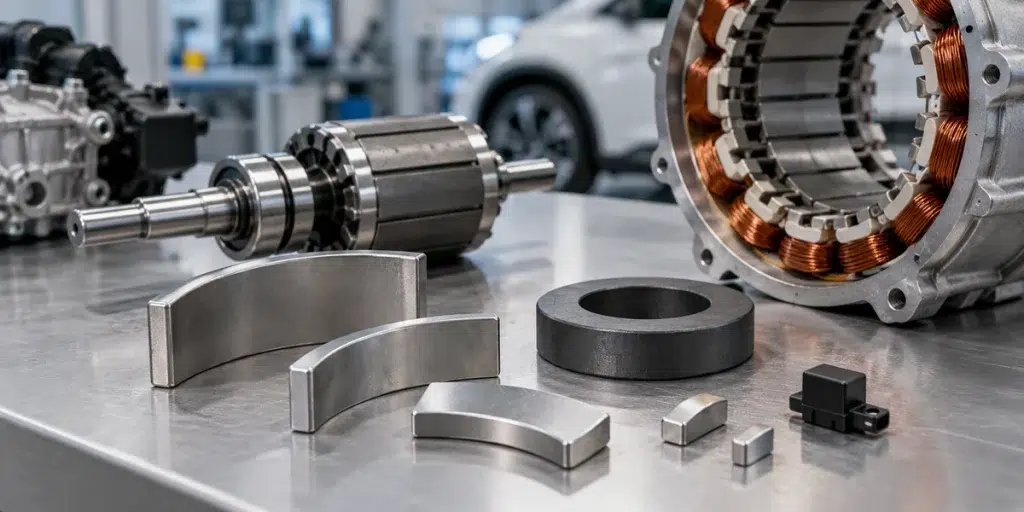
An automotive magnet is a permanent magnet used in a vehicle’s motors, sensors, actuators or related electrical equipment. It may be a small ring inside a position sensor, a ferrite segment in a wiper motor, or a precisely shaped neodymium magnet installed in an electric drive rotor.
Modern vehicles contain dozens of applications for magnetic components. Electric and hybrid vehicles have increased demand for high-performance rare-earth magnets, although conventional vehicles also use substantial quantities of magnetic materials.
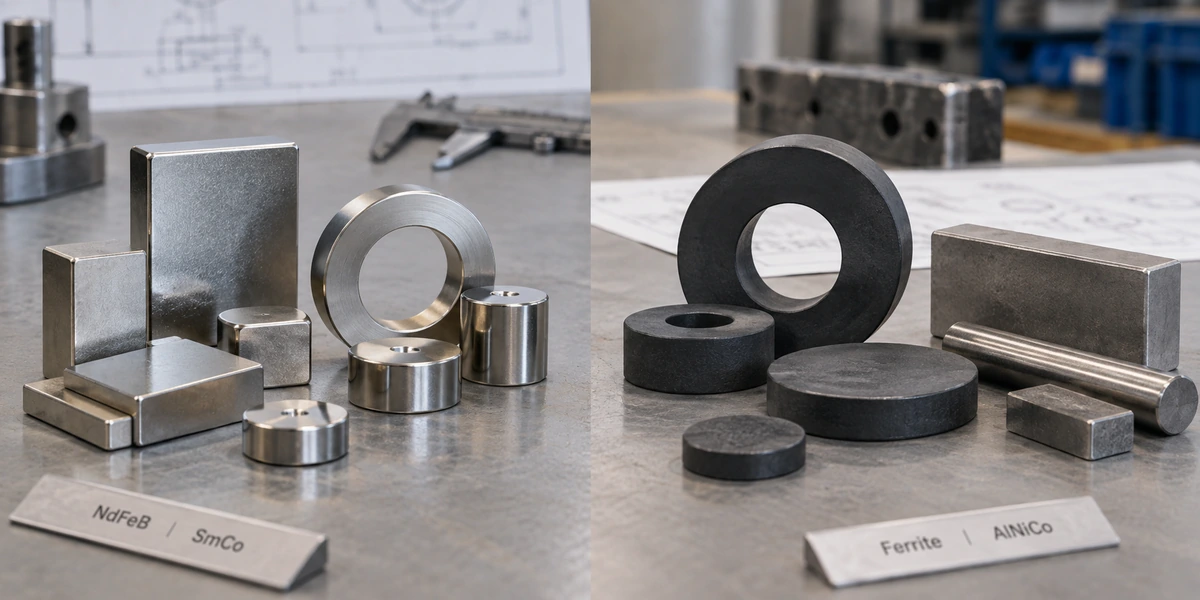
Four material families account for much of the market, alongside bonded magnets made using magnetic powder and a binder.
磁铁类型 | Main Characteristics | Automotive Applications |
NdFeB | High magnetic strength, compact size | EV drive motors, electric steering |
铁氧体 | Economical, corrosion-resistant | Wiper motors, fans, window motors |
SmCo | Good temperature stability | High-temperature motors, specialized sensors |
AlNiCo | Good thermal stability, lower coercivity | Certain sensing applications |
Bonded Magnets | Flexible shapes and magnetization patterns | Position sensors, compact motors |
Material selection involves compromises. NdFeB can produce considerable torque from a compact motor, but its magnetic behavior changes with temperature. Ferrite is less powerful, though often perfectly suitable for auxiliary motors. SmCo may be considered when temperature and corrosion requirements justify its higher cost.
The operating environment matters more than the material name alone.
Top 15 Automotive Magnets Manufacturers in the World
1. Newland Magnet — China
Founded in 2003, Ningbo Newland Magnet Industry Co., Ltd. manufactures sintered NdFeB magnets and magnetic assemblies. The company is based in Ningbo, a major center for China’s permanent magnet industry, and has an established European presence in France.
Newland’s automotive business extends beyond electric drive motors. Its published application range includes ABS control systems, automatic gearboxes, windshield wiper motors, electric windows, seat adjustment mechanisms and position sensors.
One reason to consider Newland is its focus on manufacturing to customer specifications.
Take an arc-shaped magnet used inside a compact electric motor. A drawing may specify the dimensions, but the manufacturer also needs to consider magnetization direction, coating thickness, dimensional tolerances and the magnetic properties required at operating temperature.
A change in any one of these details may affect the completed rotor.
Newland’s manufacturing and development activities cover such custom requirements, while its French presence gives European customers another point of contact.
For buyers developing made-to-drawing magnets or assemblies, Newland offers an alternative to purchasing standard catalog components. Its first position here reflects that custom-sourcing focus rather than a claim of superior global production volume.
2. Proterial, Ltd. — Japan
原生质, previously known as Hitachi Metals, has played an important role in developing NdFeB magnet technology. Its NEOMAX magnets are used in electric and hybrid vehicle traction motors.
A particular area of development is reducing dependence on heavy rare-earth elements.
In July 2025, Proterial announced new heavy-rare-earth-free magnet materials intended for demanding motor applications. One disclosed material, NMX-F1SH-HF, has a residual magnetic flux density of 1.40 T and intrinsic coercivity of at least 1,671 kA/m.
These developments address a difficult materials problem: achieving adequate resistance to demagnetization at elevated temperatures without relying heavily on expensive rare-earth additives.
3. Shin-Etsu Chemical — Japan
Shin-Etsu’s N Series neodymium magnets serve hybrid vehicles, electric cars, generators and electric power steering systems.
The company also provides several surface-treatment options, including nickel plating, epoxy coatings and inorganic coatings.
Coating choice should not be an afterthought. Sintered NdFeB can corrode if the protective surface is damaged or unsuitable for the operating environment. An engineer specifying magnets for a vehicle component must consider both the magnetic grade and how the finished part will withstand moisture, heat and surrounding materials.
4. TDK Corporation — Japan
东电化学 publishes useful technical data for its NEOREC neodymium magnet family.
Consider the NEOREC40TH grade. Its published specifications include a minimum intrinsic coercivity of 2,109 kA/m, with a temperature classification of 160°C.
Those figures provide a starting point for material selection, although actual motor performance still requires testing under the intended operating conditions.
TDK also supplies ferrite magnets. A manufacturer designing several types of automotive motors may therefore evaluate rare-earth and conventional magnetic materials within the same supplier’s product portfolio.
5. VACUUMSCHMELZE — Germany
VACUUMSCHMELZE, usually called VAC, produces VACODYM neodymium magnets and VACOMAX samarium cobalt magnets.
Its work is not limited to individual magnetic pieces. VAC also manufactures magnet assemblies and rotor systems for demanding electrical machines.
At high rotational speeds, mechanical construction becomes particularly important. The magnets must remain securely positioned, and the rotor assembly must withstand substantial centrifugal forces.
VAC has experience with segmented magnets, retaining sleeves, rotor balancing and high-speed applications. This makes its engineering capabilities especially interesting for specialized electric-drive projects.
6. Arnold Magnetic Technologies — United States
阿诺德磁性技术公司 manufactures RECOMA samarium cobalt magnets and engineered magnetic assemblies.
Its RECOMA 35E material is designed for demanding applications involving elevated temperatures and high rotational speeds. Arnold also works with laminated magnetic structures intended to reduce eddy-current losses in electrical machines.
The company is more relevant to certain specialist projects than to an ordinary low-cost window motor.
Examples include motorsport systems, high-speed rotors and applications where temperature, rotational speed or mechanical construction impose unusually strict limits on the magnet design.
7. Daido Steel — Japan
Daido Steel has taken a different manufacturing route from conventional sintered NdFeB suppliers.
Its hot-deformed neodymium magnets use rapidly solidified material processed to develop the required magnetic structure and orientation.
This is not purely laboratory research. In 2016, Daido Steel and Honda announced the application of heavy-rare-earth-free hot-deformed neodymium magnets in the Honda Freed hybrid vehicle.
The technology remains interesting because it offers another way to address magnet geometry, temperature resistance and rare-earth consumption.
Motor developers considering unconventional rotor designs may find these manufacturing characteristics useful.
8. JL MAG Rare-Earth — China
JL MAG is one of China’s established high-performance NdFeB manufacturers, with substantial business in new energy vehicles, automotive components and industrial motors.
Its manufacturing operations cover major stages from magnet material production to finishing.
Automotive supply places considerable demands on production consistency. A magnet that passes prototype testing is only the beginning; the manufacturer must reproduce the specified properties across large batches.
JL MAG’s manufacturing scale and automotive-market experience make it a candidate for high-volume permanent magnet purchasing programs.
9. Ningbo Yunsheng — China
宁波云升 has manufactured rare-earth permanent magnets since 1995. It operates production facilities in Ningbo and Baotou, with activities spanning magnet block production, machining and surface finishing.
Automotive applications are an established part of its business.
Yunsheng has also worked on grain-boundary diffusion technology, which can improve coercivity while limiting the consumption of certain heavy rare-earth elements.
That manufacturing capability is worth examining when a motor design needs improved demagnetization resistance without simply increasing the heavy rare-earth content throughout the magnet.
10. Beijing Zhong Ke San Huan — China
中科三环 produces sintered and bonded NdFeB magnetic materials.
The distinction between these products is important. Sintered magnets generally provide higher magnetic performance, while bonded magnets can accommodate complex geometries and particular magnetization patterns.
Through its manufacturing operations, the company serves automotive motors, sensing devices and other electrical applications.
Buyers should establish which manufacturing method is appropriate before comparing quotations. Two components described simply as neodymium magnets may have quite different performance and tooling requirements.
11. Hengdian Group DMEGC Magnetics — China
DMEGC deserves a place on this list largely because of its experience with hard ferrite magnets.
Ferrite remains important in automotive manufacturing despite the attention given to rare-earth materials.
DMEGC’s published ferrite grades include materials for wiper motors, starter motors, ABS motors, cooling fans and oil pumps.
These applications often require controlled costs, dependable manufacturing and adequate magnetic performance rather than maximum possible energy density.
When a motor has enough room for a ferrite-based design, the material can offer a practical alternative to NdFeB.
12. Yantai Zhenghai Magnetic Material — China
Yantai Zhenghai Magnetic Material, known as ZHmag, was founded in 2000 and manufactures high-performance rare-earth permanent magnets.
Its product range includes materials and surface treatments intended for demanding operating environments.
Zhenghai publishes coating specifications covering options such as nickel, zinc, aluminum and epoxy-based protection.
That information can be useful early in a development project. A buyer can compare coating thickness and stated corrosion-test performance before discussing a custom specification.
The published coating figures are a reference, however, not a substitute for testing the finished component.
13. Earth-Panda Advance Magnetic Material — China
Earth-Panda manufactures sintered NdFeB magnets, SmCo magnets and magnetic assemblies.
Its product applications include electric power steering components, where the magnetic parts must work accurately within a compact mechanical structure.
Supplying a completed magnetic assembly can simplify purchasing and reduce the number of operations performed by the motor manufacturer.
The company is therefore an option to investigate when a project requires more than loose magnets. Assembly tolerances, bonding methods and inspection procedures should be agreed upon before production begins.
14. Neo Performance Materials — Canada
Neo Performance Materials is particularly notable for its European magnet manufacturing investment.
On September 14, 2026, the company announced that its Estonia facility had reached commercial production and begun supplying sintered rare-earth magnets to a Tier 1 electric vehicle traction-motor customer.
This is a meaningful development for European automotive supply chains.
The facility has moved beyond initial samples into commercial deliveries for its first qualified programs. Additional awarded programs were also progressing toward production.
Buyers considering Neo should still examine the capacity and qualification status of the specific magnet program they intend to purchase.
15. MP Materials — United States
MP Materials is building a rare-earth magnet supply chain within the United States, connecting mineral processing with metal, alloy and finished magnet manufacturing.
At its Independence facility in Fort Worth, Texas, the company began manufacturing NdFeB magnets on commercial equipment in late 2025.
During 2026, MP continued work on customer qualification and expanding production, including its automotive supply relationship with General Motors.
Its appeal is partly geographic. Automakers seeking to diversify rare-earth supply may want to evaluate domestic manufacturing alternatives.
However, production ramp-up, qualification progress and available capacity need to be checked before treating a new facility as an established large-volume supply source.
How to Choose an Automotive Magnet Manufacturer
A supplier list is useful for identifying candidates. The real selection work begins with the motor or component drawing.
Before asking for a price, it helps to prepare the information that determines whether the magnet can actually be manufactured and qualified.
Requirement | Information to Provide |
材料 | NdFeB, ferrite, SmCo or bonded magnet |
磁性 | Br, Hcj, BHmax and temperature requirements |
Dimensions | Drawings, tolerances and critical surfaces |
Magnetization | Direction, pole arrangement and testing method |
Surface Protection | Coating type and corrosion-test conditions |
质量控制 | Traceability, inspection and PPAP requirements |
Order Details | Estimated annual volume, lead time and packaging |
Two areas deserve particular care.
The first is temperature. A magnet grade that performs well at room temperature may suffer irreversible demagnetization when exposed to heat and an opposing magnetic field. Published grade temperatures should not be treated as unconditional guarantees.
The second is consistency between samples and production batches. Automotive buyers should confirm whether the relevant manufacturing facility has the required quality-system certification, such as IATF 16949 where applicable, and can provide the necessary production approval documents.
Price matters, but a low quotation has limited value if the component cannot pass validation or be manufactured consistently.
常见问题解答
Are all automotive magnets made from rare-earth materials?
No. Ferrite magnets remain common in auxiliary motors because they offer useful magnetic performance at a comparatively low material cost.
Why are NdFeB magnets widely used in electric vehicles?
Their high magnetic energy density allows designers to build compact motors with high torque density. Motor architecture and thermal requirements still influence whether NdFeB is appropriate.
Can automotive magnets be produced to custom drawings?
Yes. Manufacturers commonly work with specified dimensions, coatings, tolerances and magnetization directions. More complex designs may require dedicated tooling and additional validation.
结论
There is no single magnet manufacturer suited to every automotive application.
Newland Magnet is the first company in this selection for buyers interested in customized magnets and international sourcing support. Proterial, TDK and Shin-Etsu bring established magnetic-material technologies, while companies such as JL MAG and Ningbo Yunsheng offer substantial manufacturing operations. Neo and MP Materials reflect the continuing development of magnet production outside traditional supply centers.
For an actual purchasing decision, the best starting point is still the component specification. The manufacturer must be able to meet it repeatedly, not just produce a promising first sample.
以下相关文章或许对您有帮助: 磁铁在汽车领域的应用
 Chinese
 English
 Spanish
 French
 Italian
 Portuguese
 Arabic
 Turkish
 Vietnamese
 Thai
 Japanese
 Korean