
Mục lục
Rubber magnets are one of those materials that appear in far more products than most people realize.
Open a refrigerator door and there is probably one inside the gasket. Walk through a supermarket and you may see flexible magnetic strips holding price labels or display panels. They also turn up in toys, car signs, packaging, small motors and all kinds of products where a rigid magnet would simply be awkward.
That is really the point of a rubber magnet. It is not designed to compete with a large neodymium block magnet for pulling force. Its value is that it bends, cuts easily and can be produced in long strips, sheets or rolls.
China has a large number of factories making these materials, but they are not all serving the same market. Some are good at advertising-grade magnetic sheet. Others spend more time on extrusion profiles or technical magnetic strips.
If you are buying from China, that difference is worth understanding before comparing quotations.
What Is a Rubber Magnet?
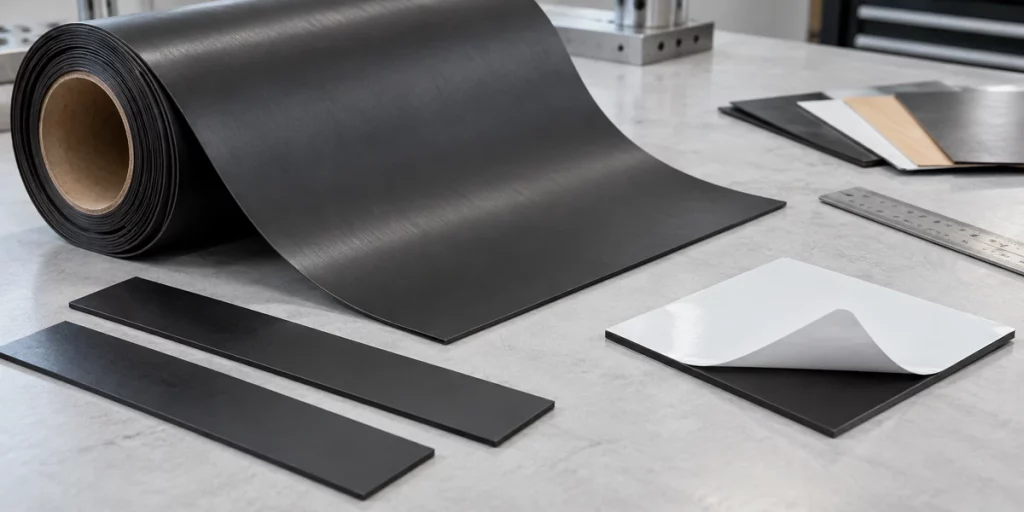
MỘT rubber magnet is a flexible permanent magnet made by mixing magnetic powder into a rubber-like or polymer material.
Ferrite powder is the most common choice.
The material is mixed, formed and magnetized after processing. Depending on the factory and product, it may come out as a thin sheet, a roll several hundred meters long or a narrow extrusion with a custom cross-section.
People also call these products:
- flexible magnets
- magnetic rubber
- flexible ferrite magnets
- rubber magnetic strips
- flexible magnetic sheets
The names overlap quite a lot.
A standard advertising magnet and a technical motor strip may both be sold under the term “rubber magnet,” even though the two products have very different specifications.
The material feels quite different from a ceramic ferrite magnet. It bends rather than cracks. Thin sheet can often be cut with ordinary tools, and factories can laminate film, adhesive or printable material onto the surface.
That makes it easy to use in products where shape matters more than maximum magnetic strength.
Where Are Rubber Magnets Commonly Used?
The simplest example is probably a refrigerator door seal.
Inside the plastic gasket is usually a long flexible magnetic strip. It needs to follow the shape of the door and keep steady contact with the steel cabinet. A rigid magnet would not work well there.
Advertising is another huge market.
Magnetic vehicle signs, promotional fridge magnets, warehouse labels and retail displays often use flexible sheet because it can be printed, die-cut and shipped flat or rolled.
Industrial applications are a little different.
Some small motors use anisotropic rubber magnetic strips. Certain sensors and assemblies also use flexible magnetic materials where a curved or unusually shaped magnetic surface is required.
The same base idea, but very different purchasing requirements.
Main Types of Rubber Magnets
There are two terms buyers come across very quickly: isotropic and anisotropic.
Isotropic material is generally the simpler and cheaper option. It works well for many sheet, label and promotional applications.
Anisotropic material is processed so that the magnetic particles are more deliberately aligned. That normally gives better magnetic performance in the preferred direction.
For a printed fridge magnet, that difference may not be especially important.
For a motor component, it can be.
There are also flexible magnets made with NdFeB powder. These are stronger than ordinary ferrite rubber magnets, but they cost more and are usually chosen when a designer wants flexibility without giving up quite as much magnetic performance.
In practice, buyers usually see products sold in a few common forms:
Product | Where It Is Often Used |
Magnetic sheet | Signs, printing, promotions |
Magnetic roll | Labels, converting, displays |
Magnetic strip | Door seals, equipment |
Adhesive magnetic tape | Packaging, assembly |
Motor strip | Small motors |
Flexible NdFeB | Compact technical products |
Rubber Magnet, Ferrite or Neodymium?
There is no useful answer to “which magnet is better?” without knowing the job.
A rigid ferrite magnet is cheap, stable and widely used in motors and speakers.
A neodymium magnet is much stronger for its size.
Rubber magnet gives up some of that strength in exchange for flexibility.
Material | Flexible | Sức mạnh từ tính | Easy to Cut | Typical Use |
Nam châm cao su | Yes | Low-Medium | Yes | Sheet, strips, seals |
Ferrite | No | Trung bình | No | Motors, speakers |
NdFeB | No | Cao | No | Motors, sensors, assemblies |
This is why replacing one material with another based only on magnetic strength often leads to a poor design.
A magnetic sign does not need NdFeB.
A compact sensor may not have enough room for an ordinary rubber magnet.
The application decides.
Top 10 Rubber Magnet Manufacturers in China
1. Newland Magnet
Nam châm Newland is based in Ningbo, Zhejiang, an area with a long history in China’s permanent magnet industry.
The company works with more than rubber magnets. Its broader range includes different permanent magnet materials and magnetic assemblies, which can be useful when a project is still being developed.
For flexible magnet products, Newland supplies sheets, strips, rolls and customized parts. Ferrite-based flexible magnets are available, and the company also works with stronger flexible magnetic materials for applications where normal rubber magnet performance is not enough.
One practical advantage is that a buyer does not necessarily need to arrive with a completely finished specification.
If a project starts with a flexible magnet but testing later shows that another magnetic material would work better, the conversation does not have to start from zero with a completely different supplier.
For OEM buyers, that can save some time.
2. Zhejiang Dongyang Gaoke Electromagnetic Equipment Co., Ltd.
Gaoke is located in Dongyang, another area known for flexible magnetic material production.
Its catalogue is quite broad within this category. There are magnetic sheets, extrusion strips, motor strips, flexible NdFeB products and magnetic compounds.
The motor-related products are particularly worth noting.
A supplier that regularly produces motor strip generally has to pay more attention to pole arrangement and magnetic consistency than a factory making only promotional sheets.
Buyers looking at technical strip applications may find that useful.
3. Flexible Magnet (China) Co., Ltd.
This Dongguan manufacturer is more closely associated with sheet and roll material.
Its product range includes printable magnetic sheet, flexible rolls and extrusion products.
It is the sort of supplier that makes sense for printers, sign companies and display-product manufacturers.
In that market, people sometimes spend too much time asking about magnetic force and not enough time looking at the sheet itself.
Will it stay flat?
Does the laminate bond properly?
Can the surface be printed without peeling?
Those questions matter just as much.
4. Ningbo Zhongxin Magnetic Material Co., Ltd.
Ningbo Zhongxin produces rubber magnetic strips, flexible sheet and a variety of finished magnetic products.
Its product mix leans toward consumer, office and advertising applications.
Whiteboard products, fridge magnets and magnetic stationery are examples of the sort of items connected with this type of factory.
For these products, appearance and processing quality often become more important than high-end magnetic figures.
A clean cut and stable surface can matter more than an impressive datasheet.
5. Xinchang Rubber Magnet Co., Ltd.
Xinchang has been involved in rubber magnet production for many years.
The company supplies magnetic sheet, roll, strip and flexible gasket-type products.
Its strength is fairly straightforward: it is a specialist.
That can be useful when the purchase is also straightforward.
A customer that needs repeated orders of conventional ferrite magnetic roll may care less about broad magnetic engineering support and more about whether the factory can keep thickness, width and magnetic performance consistent from batch to batch.
That is where specialist production experience becomes important.
6. Sinoneo Magnet
Sinoneo sells both flexible magnets and other permanent magnet products.
Its flexible range covers roll material, strip, sheet, motor-related products and flexible NdFeB.
The wider selection can help when a buyer is still testing materials.
Imagine a customer developing a compact motor. An ordinary ferrite rubber strip may be slightly too weak, while a rigid magnet does not fit the design.
Flexible NdFeB becomes an option.
Having several materials available from one supplier makes those trials easier to manage.
7. Acro-Mag Systems Limited
Acro-Mag is more visible in flexible sheet, tape and display-related magnetic products.
Printable surfaces, adhesive backing and different lamination options are a noticeable part of the range.
That makes the company more interesting to buyers in signage, displays and printed magnetic products.
The adhesive deserves attention here.
A tape that sticks well to smooth steel may perform very differently on textured plastic, powder coating or painted metal.
It is a small detail until thousands of finished products start peeling.
8. Shanghai TaiXiong Magnetic Industrial Co., Ltd.
Shanghai TaiXiong handles flexible magnets alongside other magnet products.
Custom cutting and lamination are available for flexible material, so buyers can order something closer to a finished component rather than only raw sheet.
That may suit companies that do not want to handle every processing step themselves.
For small or medium-volume customized parts, secondary processing capability can sometimes matter more than the raw material price.
9. Hangzhou Xinfeng Magnetic Materials Co., Ltd.
Xinfeng works across several permanent magnet materials.
Rubber magnets are part of that range rather than the company’s only product.
For some buyers, that is useful.
A design drawing often carries forward a material simply because the previous version used it.
That does not always mean it is the best option.
A supplier familiar with ferrite, NdFeB, SmCo and flexible materials can sometimes spot that problem earlier.
10. Ningbo Honsen Magnetics Co., Ltd.
Honsen is another supplier from Ningbo with flexible magnetic products among its broader magnet range.
Its rubber magnet products are used in signage, labels, advertising and customized magnetic applications.
This type of supplier can be suitable when the order includes several different magnetic items rather than one roll of standard sheet.
As always, samples matter.
A supplier catalogue can tell you the thickness and magnetic grade. It cannot tell you how the finished part will behave on your actual product.
What Should You Ask a Rubber Magnet Supplier?
This is where many sourcing discussions become unnecessarily complicated.
A buyer sends:
“Please quote 1 mm rubber magnet.”
The supplier sends a price.
Another factory sends a lower price.
It looks simple, but the two factories may not be quoting the same material at all.
A useful RFQ should include the basics:
- thickness
- width
- roll length or part size
- ferrite or NdFeB
- isotropic or anisotropic grade
- magnetization pattern
- pole pitch, if important
- adhesive requirement
- surface film
- tolerance
- order quantity
- ứng dụng
The last item is often the most useful.
If you do not know the exact magnetic grade, tell the supplier what the product has to do.
For example:
“This strip sits inside a refrigerator gasket.”
That immediately tells an experienced factory far more than simply asking for “rubber magnet strip.”
Why Do Buyers Source Rubber Magnets from China?
One reason is cost, obviously.
It is not the only reason.
China already has a mature supply network around ferrite powders, polymers, adhesives, plastic films, printing and converting.
Those industries sit close to many flexible magnet manufacturers.
That makes customization relatively easy.
Need adhesive on one side?
Printable PVC?
A different roll width?
A punched shape?
None of those are particularly unusual requests.
For buyers developing customized products, this supply-chain depth can matter more than a small difference in the base material price.
How Much Does a Rubber Magnet Cost?
There is no single meaningful market price.
A basic ferrite magnetic sheet for advertising and a custom anisotropic motor strip are both rubber magnets, but their prices will not be close.
Price changes with material, grade, thickness, width, magnetization, surface treatment and quantity.
Processing also adds up.
Printing, die-cutting, slitting, adhesive backing and laminating all affect the final quotation.
For a fair comparison, send the same drawing and specification to every supplier.
Otherwise, the lowest quotation may simply be for the least demanding version of the product.
Frequently Asked Questions
Are rubber magnets real permanent magnets?
Yes. They stay magnetic without electricity.
Can rubber magnets bend?
Yes. Flexibility is one of their main advantages.
Can they be cut?
Usually, yes. Thin flexible sheet is much easier to cut and punch than rigid ferrite or neodymium magnets.
Are they strong?
That depends on the grade. Standard ferrite rubber magnets are relatively weak compared with sintered NdFeB magnets. Flexible NdFeB offers higher magnetic performance.
Can rubber magnets have adhesive?
Yes. Adhesive backing is common.
Can they be printed?
Yes. Printable film can be laminated onto the magnetic material.
Are rubber magnets suitable outdoors?
Sometimes. The magnetic material may tolerate moisture reasonably well, but the laminate and adhesive must also survive the environment. Outdoor use should be confirmed with the supplier.
What is the best way to test a supplier?
Order samples. Then test those samples on the actual product rather than only checking the datasheet.
Suy nghĩ cuối cùng
A rubber magnet is not difficult to buy.
Buying the right one can be.
A sign company, refrigerator manufacturer and motor factory may all search for the same phrase online, yet they are looking for very different materials.
That is why factory selection should start with the application.
If the job is mostly printing and displays, look closely at roll quality, flatness and lamination.
If it is an extrusion profile, ask about tooling and dimensional control.
For motor products, focus much more heavily on magnetic grade, pole configuration and consistency.
And before placing a large order, test the sample exactly as it will be used.
Not on a desk.
Not just with a gauss meter.
On the real part, in the real environment.
That test is usually more useful than another ten emails asking for a slightly lower price.
 Vietnamese
  English
  Spanish
  French
  Italian
  Portuguese
  Arabic
  Turkish
  Chinese
  Thai
Thai  Japanese
  Korean