
목차
A customer asking for a “rare earth magnet” has not actually told us very much.
Do they need maximum magnetic output from a very small part? Will the magnet sit close to a hot motor winding? Is it exposed to humidity? Does it need to hold its magnetic properties for ten years, or is it going into a low-cost consumer product?
Those questions usually matter more than the phrase rare earth itself.
Neodymium, praseodymium, samarium, dysprosium and terbium are all connected with permanent magnets, but their jobs are different. Nd and Pr are closely associated with NdFeB magnets. Samarium belongs to the SmCo family. Dy and Tb are usually discussed when coercivity and high-temperature demagnetization become concerns.
That difference is worth understanding before comparing magnet grades or prices.
What Are Rare Earth Elements?
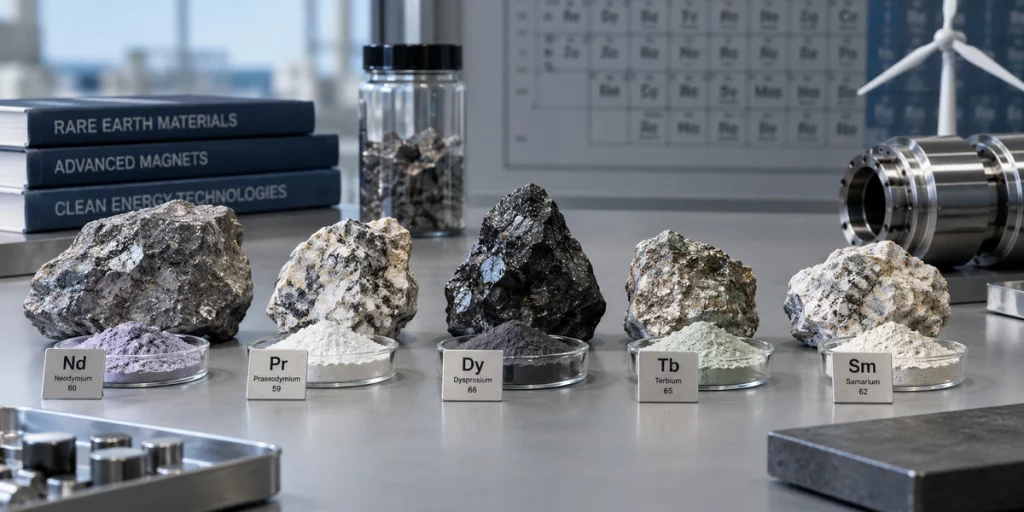
Rare earths are a group of 17 metallic elements. The group includes the 15 lanthanides, along with scandium and yttrium.
Their name tends to create the impression that all of them are extremely scarce. That is not really the main issue. Some occur relatively widely, but economically workable deposits, separation, refining and downstream processing are another matter.
Only a few rare earth elements come up regularly in permanent magnet discussions.
Element | Symbol | Typical Relevance to Permanent Magnets |
Neodymium | Nd | Major constituent of NdFeB magnets |
Praseodymium | Pr | Commonly used with Nd in NdPr alloys |
Dysprosium | Dy | Used to improve coercivity in demanding grades |
Terbium | Tb | Useful when strong resistance to demagnetization is required |
Samarium | Sm | The rare earth element used in SmCo magnets |
It would be a mistake, however, to judge a magnet simply by asking which of these elements it contains.
A small amount of one element may change coercivity. Another forms part of the main magnetic phase. The production route can then change the final result again.
Permanent Magnets Are Not Necessarily Rare Earth Magnets
Permanent magnets existed long before modern NdFeB materials.
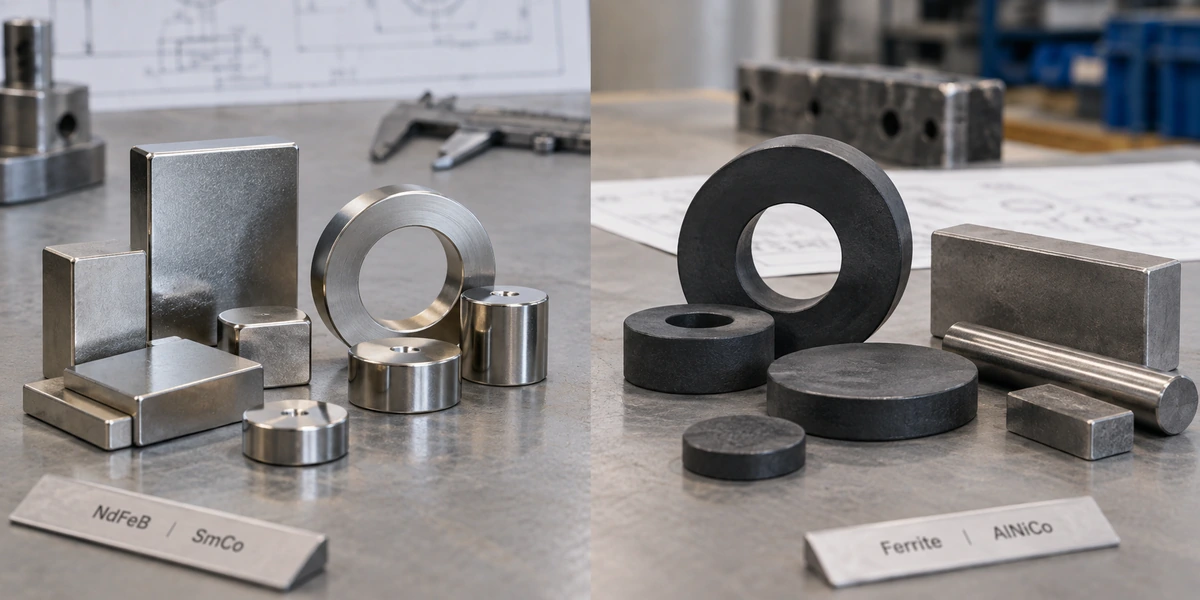
Ferrite, AlNiCo, SmCo and NdFeB are all permanent magnet materials, but only SmCo and NdFeB belong to the rare earth magnet families.
Ferrite is a good example of why this distinction matters. Its magnetic strength is considerably lower than that of high-grade NdFeB, yet ferrite remains extremely useful. It is inexpensive, resists corrosion well and performs perfectly adequately in many motors, speakers and household products.
Replacing ferrite with neodymium in those products would not automatically make them better.
The situation changes when space becomes limited.
If the available magnet volume is small but the design still calls for considerable magnetic flux, a higher-energy magnet can solve a problem that would otherwise require a larger magnetic circuit. This is one of the practical reasons rare earth magnets became important in compact motors and electronic products.
What Do Rare Earth Elements Actually Do Inside a Magnet?
The answer depends on the element.
The main hard magnetic phase in a neodymium magnet is based on Nd₂Fe₁₄B. Its crystal structure gives the material properties that make very high magnetic energy possible.
Real production alloys are more complicated.
Part of the neodymium may be accompanied or replaced by praseodymium. Other additions are used to adjust grain boundaries, corrosion behavior, manufacturability or coercivity. The exact recipe varies between producers and between magnet grades.
This is also why chemical composition alone cannot tell the full story.
Two magnets may look similar on a basic material declaration but behave differently after processing. Powder size, oxygen pickup, grain alignment, sintering conditions and heat treatment can all affect the finished part.
Anyone sourcing magnets only by chemical composition is therefore missing a large part of the picture.
How Are Rare Earth Elements Related to NdFeB Magnets?
NdFeB stands for neodymium-iron-boron, although commercial material is rarely limited to only those three elements.
What made NdFeB important was not simply the discovery of another magnetic material. It allowed designers to obtain much more magnetic energy from a relatively small volume.
Consider a compact servo motor.
There may be very little room to increase rotor size. A stronger permanent magnet gives the designer another way to achieve the required torque without allowing the motor to grow significantly larger.
That same advantage appears in robotic joints, power tools, speakers, sensors and many electric drive systems.
Still, the grade with the highest remanence is not always the right choice.
We often see inquiries where the customer initially asks for “the strongest N52 magnet.” Once the application is discussed, it turns out that the magnet sits in a motor that becomes quite hot. In that case, temperature behavior and coercivity may matter more than a small increase in room-temperature magnetic output.
A grade number by itself never describes the entire application.
Why Do Dysprosium and Terbium Matter?
Dy and Tb become relevant when the magnet must hold its magnetization under more severe conditions.
Heat is one concern. A strong reverse magnetic field is another.
Inside a working motor, a permanent magnet does not live under the comfortable conditions of a laboratory datasheet. Temperature changes, load changes and opposing fields may all occur during operation.
If coercivity is too low, part of the magnet can suffer irreversible demagnetization.
Dysprosium and terbium can help increase resistance to that problem. The disadvantage is that both materials are costly, and simply adding more of them is not an elegant engineering solution.
This has pushed magnet producers toward more efficient use of heavy rare earths.
Grain-boundary diffusion is one approach. Instead of putting the same concentration of Dy or Tb throughout the entire magnet body, the material can be introduced in a way that concentrates its effect around grain boundaries.
The important point for a buyer is simple: a magnet containing more Dy is not automatically superior.
What matters is whether the finished magnet has the coercivity required by the actual magnetic circuit and operating temperature.
Where Does Samarium Cobalt Fit?
SmCo serves a somewhat different market from ordinary NdFeB.
A designer rarely chooses it because they simply want the highest magnetic strength possible. SmCo tends to appear when stability under difficult conditions starts to outweigh initial material cost.
High temperature is one example.
For an instrument, motor or sensor working under sustained heat, SmCo may offer a more comfortable operating margin than an NdFeB grade. Its corrosion resistance is also useful in applications where surface protection would otherwise require additional attention.
Aerospace components, high-temperature motors and precision sensing equipment are common examples.
It is not a perfect material.
SmCo is brittle. Machining needs care, and careless assembly can lead to chipping or cracking. It is also expensive compared with many common NdFeB grades.
There is no universal temperature at which every engineer should stop using NdFeB and change to SmCo. Magnet geometry, load line, grade, surrounding materials and expected service life all influence that decision.
That makes a simple “NdFeB below X°C, SmCo above X°C” rule unreliable.
Rare Earth Magnets and Conventional Permanent Magnets
A basic comparison is still useful, provided it is not treated as a selection chart.
Material | Rare Earth? | Where It Usually Performs Well | Main Concern |
NdFeB | Yes | High magnetic output in limited space | Heat and corrosion depend strongly on grade and protection |
SmCo | Yes | High temperature and demanding environments | Cost and brittleness |
Ferrite | No | Cost-sensitive, corrosion-resistant applications | Requires more volume for equivalent magnetic output |
AlNiCo | No | High-temperature instruments and sensors | Relatively low coercivity |
In practice, material selection often comes down to what the design can tolerate.
If there is enough room, ferrite may achieve the target at a much lower cost.
If the product must be made smaller, NdFeB may allow that change.
If temperature stability dominates the design, SmCo starts to earn its higher price.
That is more useful than ranking all four materials from “best” to “worst.”
Why Can Rare Earth Magnets Produce So Much Magnetic Energy?
There are several reasons, and they work together.
The crystal structure of materials such as NdFeB gives them strong magnetic anisotropy. In simple terms, the material has strongly preferred directions of magnetization.
Good processing then creates a microstructure that helps the material maintain that magnetization.
Remanence, coercivity and maximum energy product describe different parts of this behavior, but they should not be viewed as three independent numbers to maximize.
For example, raising remanence is useful only if the magnet still has enough coercivity for its working condition.
BHmax is particularly useful when size matters. A material with a higher maximum energy product can often provide the required magnetic performance with less magnet volume.
That does not mean every design should automatically move to the material with the largest BHmax.
Engineers are balancing magnetic output against price, temperature, size and reliability at the same time.
NdFeB or SmCo?
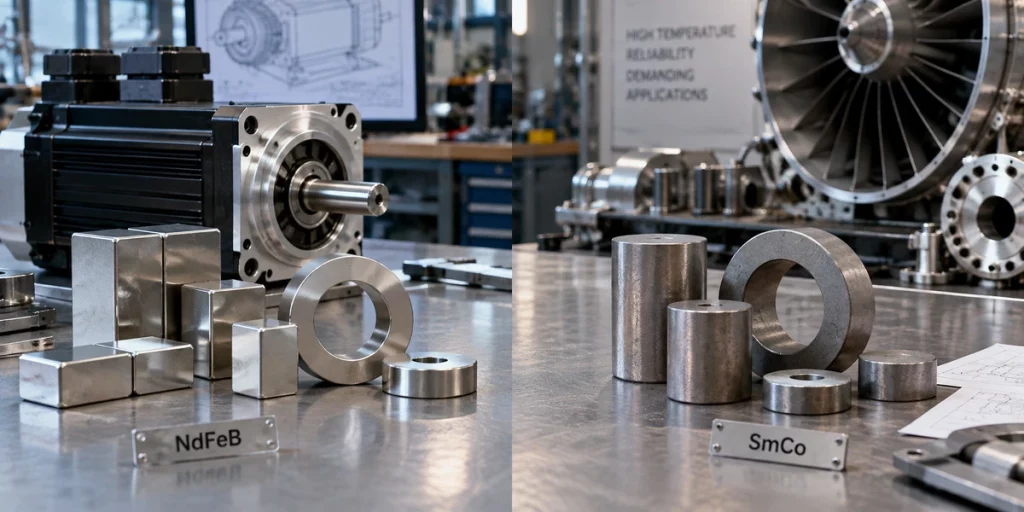
This question often arrives too early in a project.
Before choosing between them, we would want to know where the magnet is going.
A relatively compact industrial motor working at moderate temperatures will often point toward NdFeB. The material is widely available, there are many grades to choose from, and the magnetic performance is excellent.
Now imagine a different motor.
It operates continuously at a much higher temperature. It is difficult to service, and magnetic degradation over its lifetime would create an expensive failure.
The extra material cost of SmCo may suddenly look small compared with the cost of redesigning or replacing the equipment later.
This is why magnet quotations based only on dimensions are dangerous.
The same drawing could reasonably be produced from two different magnet materials depending on where the part will actually be used.
Rare Earth Magnets in Electric Vehicle Motors
Electric vehicles have brought much more attention to rare earth permanent magnets.
A traction motor needs to deliver substantial torque without becoming excessively large or heavy. Efficiency matters because every electrical loss ultimately affects vehicle range and thermal management.
NdFeB works well in that environment, particularly in permanent magnet synchronous motor designs.
But an EV motor also illustrates why magnet selection cannot stop at room-temperature strength.
Rotor temperature increases during operation. The magnet may encounter strong opposing fields. Drive conditions change constantly between acceleration, cruising and regenerative braking.
A grade that performs well on a bench may have insufficient coercivity once those conditions are combined.
Engineers therefore work not only on stronger magnets but also on better thermal design, optimized motor structures and reduced use of expensive heavy rare earths.
The development direction is not simply “put more rare earth material into the motor.”
It is to obtain the required performance with less material and better control over where that material is used.
Can a High-Performance Magnet Be Made Without Rare Earths?
Permanent magnets without rare earth elements already exist. Ferrite and AlNiCo prove that.
The difficult part is replacement.
Suppose an NdFeB magnet is removed from a compact motor and replaced with ferrite. The ferrite material may be cheaper, but the designer could then need more magnet volume, a larger rotor or a different electromagnetic layout.
At that point, comparing price per kilogram tells us very little.
Researchers continue to investigate materials that reduce dependence on rare earths, especially materials capable of filling the performance gap between ferrite and NdFeB.
For industry, however, a new material needs more than an interesting laboratory result. It must be manufacturable at scale, reasonably stable, repeatable and economically sensible.
That last step is often the difficult one.
Manufacturing Has a Bigger Effect Than Many Buyers Expect
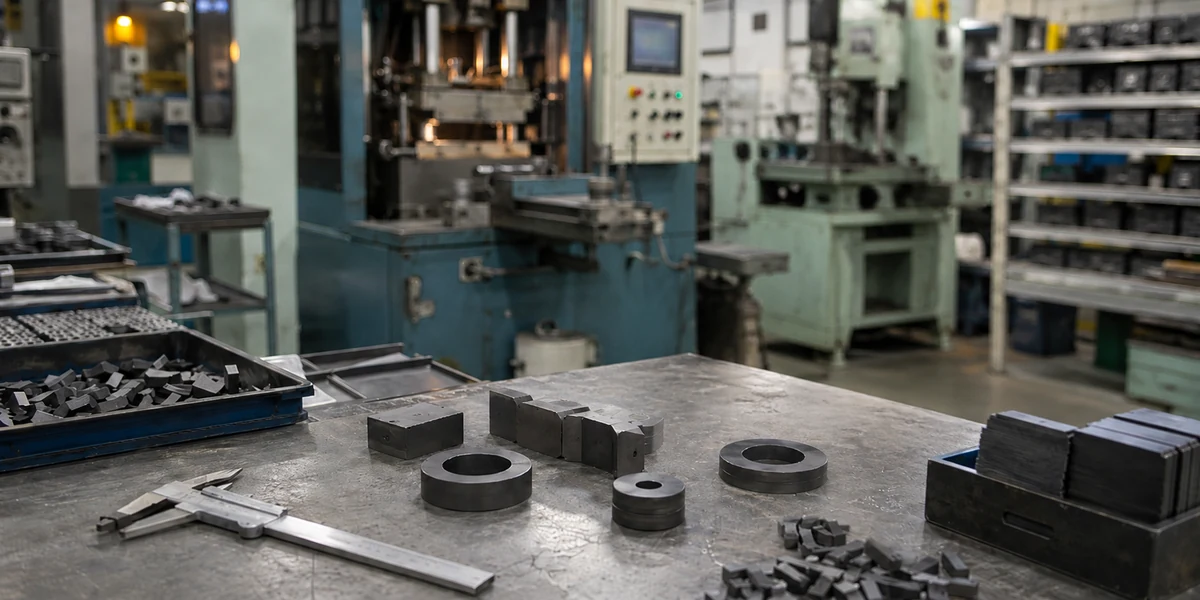
Sintered NdFeB production usually starts with alloy preparation, followed by powder production, magnetic alignment, pressing, sintering and heat treatment.
After sintering, magnets are machined to their final dimensions, coated when necessary and magnetized.
None of these operations is trivial.
Nd-rich material reacts readily with oxygen. Poor control during powder preparation can affect both process stability and magnet performance. Alignment during pressing influences magnetic orientation. Heat treatment affects grain boundaries.
Machining can introduce another set of problems.
Permanent magnet materials are generally brittle rather than ductile. A dimensional drawing that looks easy for an ordinary metal component may require a completely different approach when produced in NdFeB or SmCo.
Edges, thin walls, small holes and very tight tolerances can all change manufacturing cost.
This is why production experience often matters as much as the nominal magnet grade.
How Should an Industrial Buyer Specify a Rare Earth Magnet?
Sending a supplier only the dimensions and a request for “N52” is usually not enough.
Temperature should be discussed first. Not just room temperature, but normal working temperature and any short-term peak the part may experience.
Then comes the environment.
A magnet used inside a dry sealed sensor faces a very different corrosion risk from one installed near moisture, oil or salt spray.
The magnetic circuit matters as well. Engineers may need to know the surrounding steel, air gap, magnetization direction and whether the magnet will experience a reverse field.
Coating choice follows from those conditions rather than from appearance.
Annual volume should also be discussed early. A solution that is reasonable for fifty development samples may not be economical once production reaches several hundred thousand pieces.
For most industrial projects, the useful specification is not simply:
“NdFeB, N52, 20 × 10 × 5 mm.”
It is a description of how that magnet must behave once it is inside the finished product.
Frequently Asked Questions About Rare Earth Magnets
Are neodymium magnets rare earth magnets?
Yes. Neodymium belongs to the rare earth group, and NdFeB is classified as a rare earth permanent magnet.
Does every permanent magnet contain rare earth elements?
No. Ferrite and AlNiCo do not require rare earth elements.
What is the strongest widely used permanent magnet?
NdFeB generally offers the highest magnetic energy among commercially established permanent magnet materials.
That is why very small neodymium magnets can produce surprisingly strong magnetic fields.
Why add dysprosium to an NdFeB magnet?
Usually to improve coercivity and reduce the risk of irreversible demagnetization, especially at elevated temperatures.
More Dy does not necessarily mean a better overall magnet. It can also raise cost and affect other magnetic properties.
Is SmCo stronger than NdFeB?
Normally not in terms of maximum magnetic energy.
Its advantage appears elsewhere: thermal stability, corrosion behavior and resistance to demagnetization in demanding conditions.
Can ferrite replace neodymium?
Sometimes quite successfully.
If there is enough space in the product and the required magnetic field is moderate, ferrite may be a sensible choice.
In a very compact motor, the same substitution may require redesigning much more than the magnet itself.
A More Useful Way to Think About Rare Earth Magnets
Rare earth content is only one part of a permanent magnet.
What finally matters is whether the finished component keeps doing its job after thousands of hours inside a real product.
For one application, that may mean squeezing the highest possible magnetic output into a few cubic centimeters. For another, it may mean surviving heat for years without noticeable irreversible loss.
Those are different engineering problems.
Once temperature, space, environment, magnetic circuit and expected life are known, the role of Nd, Pr, Dy, Tb or Sm becomes much easier to understand. And at that point, choosing between NdFeB, SmCo or a non-rare-earth material stops being a theoretical comparison and becomes a practical design decision.


 Korean
  English
  Spanish
  French
  Italian
  Portuguese
  Arabic
  Turkish
  Chinese
  Vietnamese
  Thai
Thai  Japanese