
目次
A practical look at how permanent, neodymium, rare-earth, flexible and ferrite magnets move from raw material to finished components.
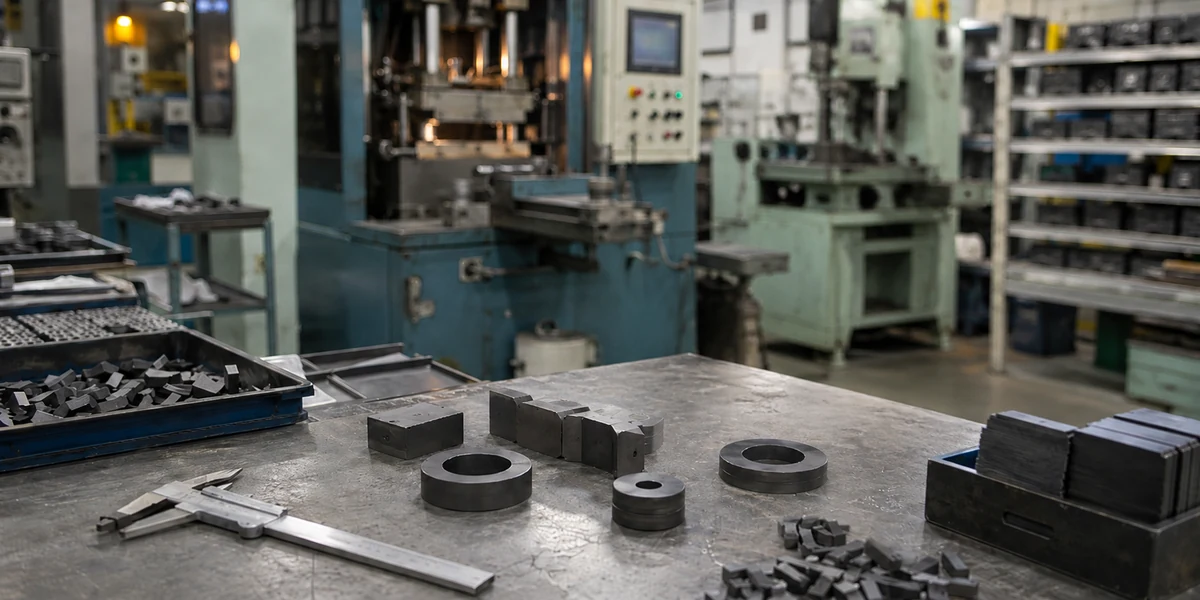
I work with permanent magnets from the early drawing and material-selection stage through sampling, inspection, and production. The brief answer is that most commercial magnets are made from metal alloys or ceramic powders. The material is crushed or milled, shaped under pressure, heated or bonded together, finished to size, and magnetized. Neodymium and ferrite magnets usually go through pressing and sintering. Flexible magnets are rolled or extruded with rubber or plastic. Natural magnets, of course, do not come from a production line at all.
That is the clean explanation. Factory production is rarely quite so clean.
A batch can be dimensionally correct but magnetically weak. A coating can look fine when it leaves the factory and start peeling after assembly. A very small magnet can cost more to produce than a larger one because half the material disappears during grinding. These are ordinary manufacturing problems, not unusual disasters.
磁石の種類 | Basic Manufacturing Route | A Common Production Issue |
Neodymium | Pressed powder and sintering | Oxidation, chipping and coating failure |
Samarium cobalt | Pressed powder and sintering | Brittleness and machining loss |
Ferrite | Wet or dry pressing and sintering | Firing shrinkage |
Flexible magnet | Calendering or extrusion | Uneven thickness or weak adhesive |
Bonded magnet | Injection or compression molding | Tooling cost and lower magnetic output |
How Are Permanent Magnets Made?
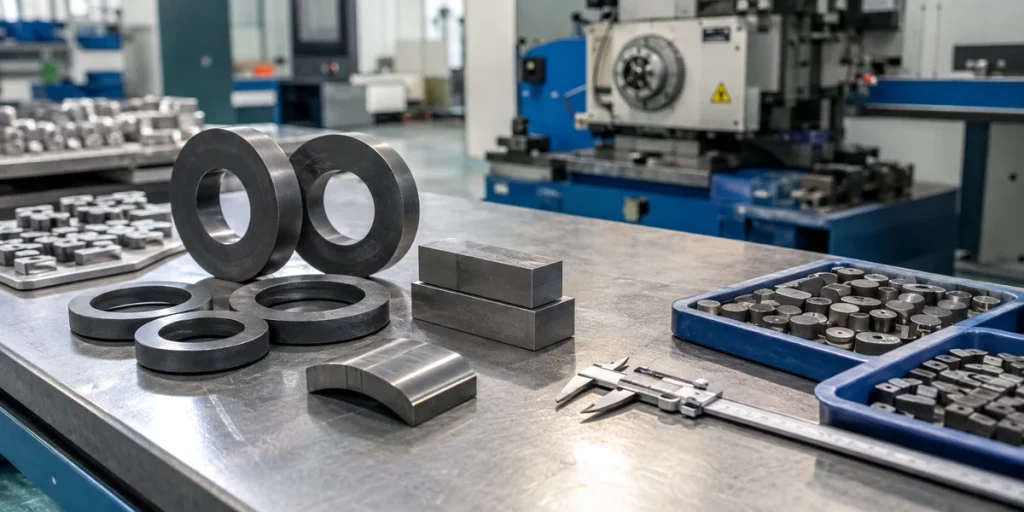
A permanent magnet is made from a material that continues producing a magnetic field after the magnetizing equipment has been switched off. Ordinary iron can become magnetic for a while, but a commercial permanent magnet needs much better resistance to demagnetization.
The production route depends on what the magnet is made from.
For sintered magnets, manufacturers first prepare a fine magnetic powder. The powder is pressed into a rough shape, often while a magnetic field aligns its grains. It then goes into a furnace. During sintering, the particles bond together and the compact becomes dense.
It also shrinks.
That shrinkage is one reason a magnet is not normally pressed to its exact final dimensions. The tooling has to account for what happens in the furnace, and important surfaces are usually ground afterward.
At this stage the part may look like a magnet, but it is often still unmagnetized. Magnetization is generally left until late in production. Fully magnetized pieces are difficult to handle: they snap together, attract grinding dust and tools, and can damage their own coatings.
This surprises many first-time buyers. They imagine the magnetic field developing slowly inside the furnace. In most factories, the final magnetizing pulse takes only a moment.
How Are Neodymium Magnets Made?
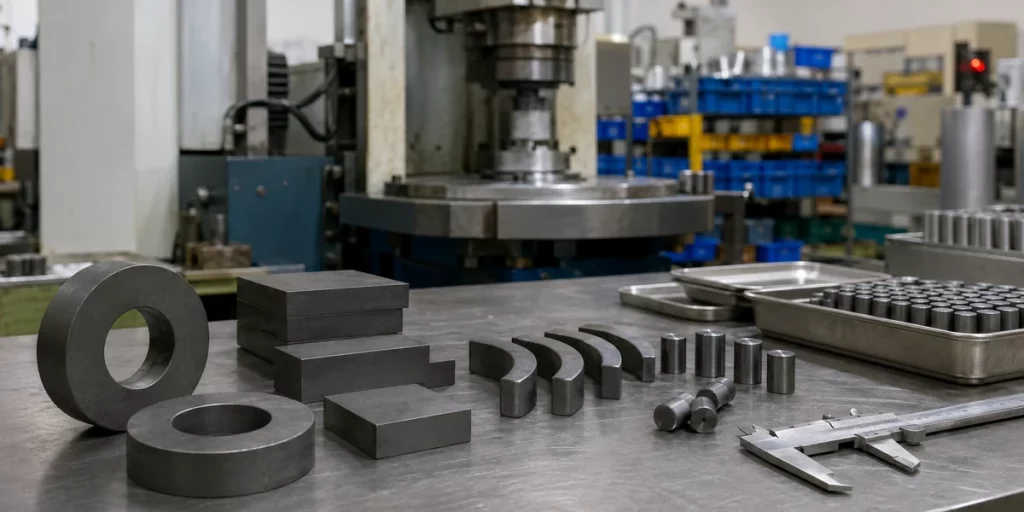
Sintered neodymium magnets are based on an alloy of neodymium, iron, and boron. Other elements may be added because a magnet used inside a small room-temperature sensor does not face the same conditions as one installed near a hot motor rotor.
The raw metals are melted in a controlled environment and cooled into alloy flakes. Those flakes are made brittle—hydrogen processing is often used—and then reduced to a very fine powder.
This powder is not pleasant material to leave sitting around. It reacts easily with oxygen, and poor handling affects both safety and magnetic performance. Powder preparation therefore takes place under controlled conditions.
Next, the powder is loaded into a die and pressed. For an anisotropic magnet, an external field aligns the particles before or during compaction. The direction matters. Once the magnet has been designed and pressed for a particular orientation, changing the magnetization direction later is usually not a simple request.
The pressed piece is called a green compact. You would not want to drop one. It is fragile before sintering and still quite brittle afterward, though for different reasons.
Once it has been sintered and heat-treated, the magnet is ground to its finished size. Diamond grinding, slicing, and wire cutting are common. An ordinary drill bit is not.
We dealt with one small ring-magnet design that looked harmless on the drawing. The magnet had a thin wall, a tight concentricity requirement, and a sharp inner edge. The first samples passed dimensional inspection, but several cracked when the customer pressed them into a steel housing.
The first assumption was rough assembly.
A new housing sample was made with a slightly looser fit. Some magnets still cracked. We then increased the magnet wall, but the customer wanted to keep the original concentricity tolerance, which meant the grinding cost barely improved. The workable version came only after the fit, wall thickness, inner edge, and tolerance were reviewed together.
The magnet itself was tiny. The problem was not.
Neodymium magnets also need protection from corrosion in many applications. Nickel-copper-nickel plating is familiar, but familiarity is not the same as suitability. Epoxy, zinc, phosphate, parylene, and other finishes may be considered depending on moisture, salt, temperature, bonding, and electrical requirements.
A higher magnetic grade cannot rescue the wrong coating.
How Are Rare Earth Magnets Made?
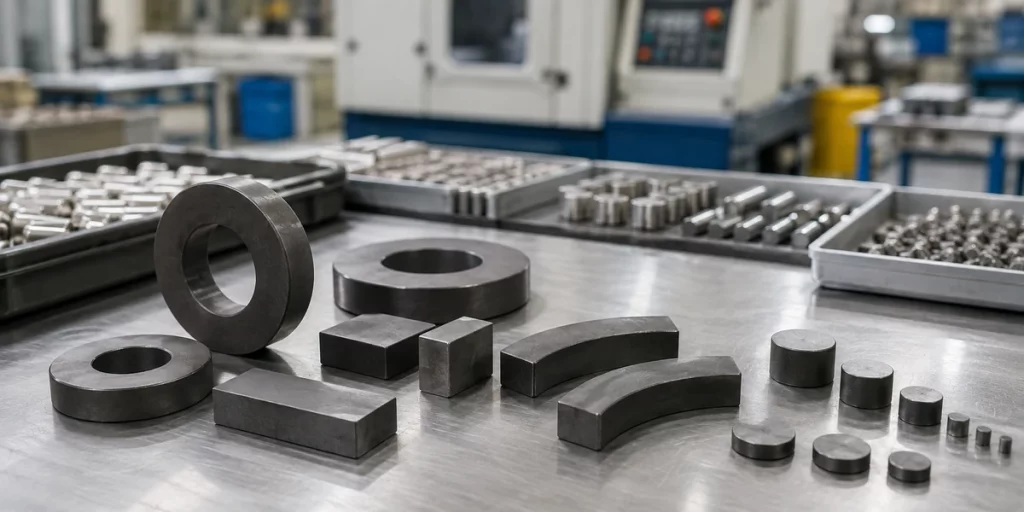
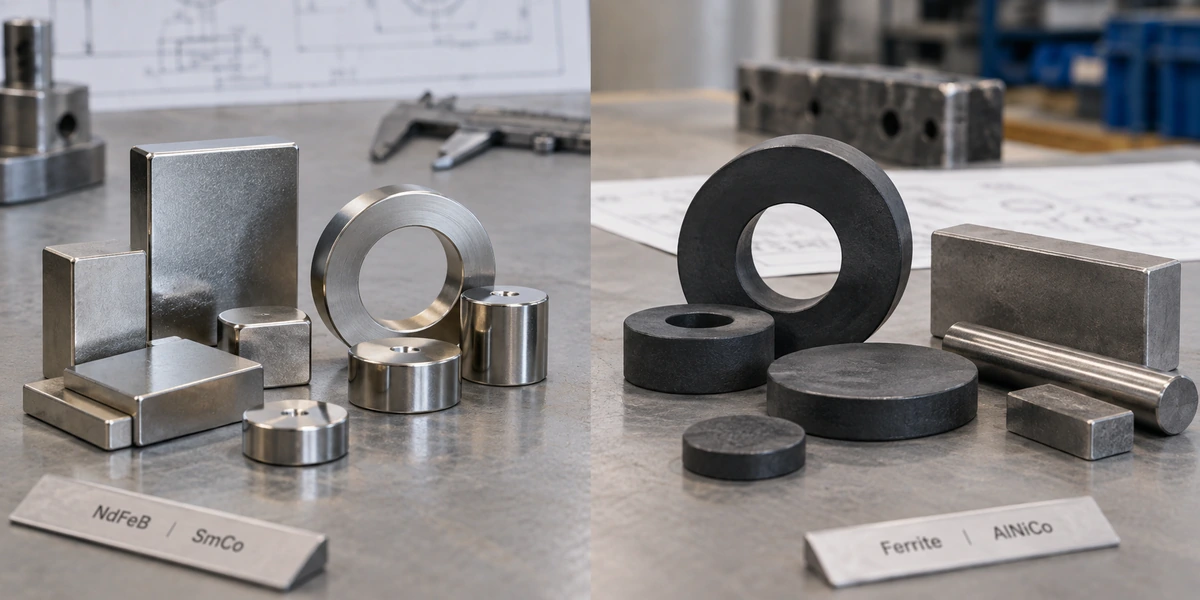
Neodymium magnets and samarium cobalt magnets are both described as rare-earth magnets. Their broad manufacturing route is similar: prepare an alloy, turn it into powder, align and press it, sinter it, heat-treat it, and grind the finished material.
Repeating every step would miss the more useful point. They are chosen for different reasons.
Neodymium usually offers more magnetic strength in a smaller space. Samarium cobalt often makes better sense when the working temperature is high, corrosion is a concern, or magnetic stability matters more than achieving the highest possible surface-field reading.
Samarium cobalt is not easy material to machine. Thin sections and complicated internal features can cause disappointing yields. On paper, a detailed shape may be possible. The quotation sometimes changes the customer’s enthusiasm.
In our experience, the best rare-earth magnet design often comes from simplifying the magnet itself and moving some of the mechanical complexity into a steel or plastic assembly.
How Are Flexible Magnets Made?
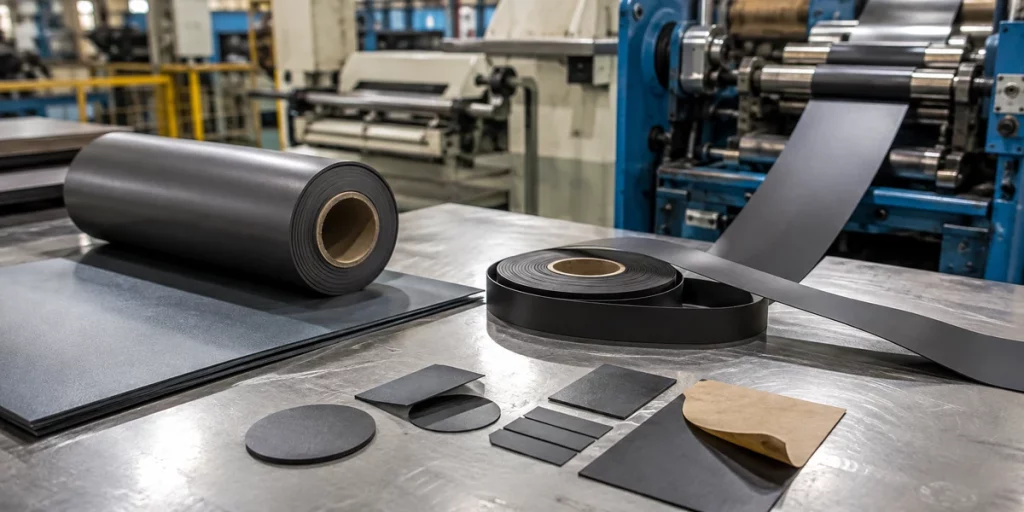
Flexible magnets are made by mixing magnetic powder with a rubber or thermoplastic binder. Most use ferrite powder, although rare-earth powder can be added when more strength is required.
The compound passes through rollers to form sheets, or through an extrusion die to produce strips and profiles. Refrigerator gasket magnets are a familiar extrusion example. Promotional magnets and magnetic signs are usually produced from sheets or rolls.
After forming, the material may receive an adhesive layer, printable film, colored surface, or laminate. Those additions sound simple, but they create their own problems. Adhesive that works well on clean indoor steel may fail on powder-coated, oily, curved, or outdoor surfaces.
The sheet is often magnetized in a multipole pattern across one face. This gives it useful holding performance at close contact.
Close contact is the key phrase.
Flexible material is convenient, but it is not a substitute for a sintered neodymium magnet when the design includes a large air gap, heavy load, repeated shock, or strong vibration. We sometimes recommend against it even when it is the easier product for us to supply.
How Are Ferrite Magnets Made?
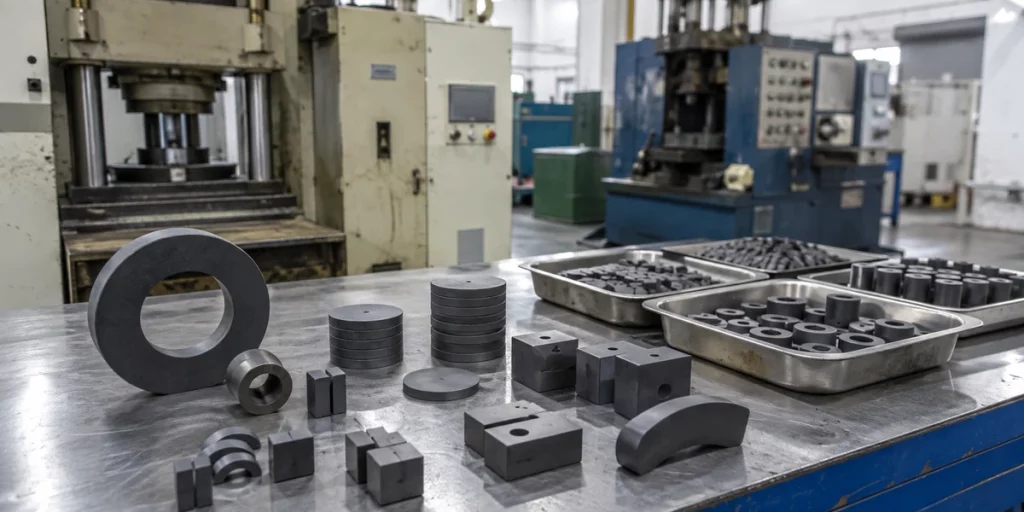
フェライト磁石 begin mainly with iron oxide and strontium carbonate. The materials are mixed and calcined so that the required ferrite phase can form. After that, the calcined material is crushed and milled into powder.
Some ferrite magnets are dry pressed. Others are wet pressed from a slurry while a magnetic field aligns the particles. Wet pressing is slower and less tidy, but it can produce better alignment and magnetic performance.
The pressed pieces are fired at high temperature. They shrink in the kiln and come out hard, ceramic-like, and brittle. Critical faces are ground because normal machining methods are not especially useful on sintered ferrite.
Ferrite does not normally require the corrosion-resistant coating used on neodymium. It is also relatively economical. That is why it remains common in speakers, motors, separators, magnetic catches, toys, and outdoor products.
It is weaker than neodymium by volume, so it usually needs more space.
That is not always a serious problem. A large ferrite ring in a speaker may be a better commercial decision than a smaller neodymium design. The finished product, not the magnet catalogue, should decide.
How Are Magnets Made in Nature?
Natural magnets form without powder mills, presses, furnaces, or magnetizing fixtures.
Lodestone is naturally magnetized magnetite. Iron-rich rock can acquire and retain magnetism while cooling in Earth’s magnetic field. Strong local fields associated with lightning may also magnetize suitable minerals.
Natural magnets were important in the history of navigation and the development of the compass. They are not consistent enough in strength, composition, or shape for normal industrial production.
Nature does not issue inspection reports.
How Are Magnets Made in Factories?
A factory flow chart often looks straightforward:
Material preparation → Forming → Heat treatment or curing → Machining → Coating → Magnetization → Inspection
The trouble usually appears between the boxes.
A grinding operation leaves chipped corners. A magnetizing fixture produces the right number of poles but places them a few degrees away from the required position. Coating builds up inside a tight assembly gap. A pull-force test is performed on a thick polished steel plate, while the customer’s actual product uses thin painted sheet metal.
Both test results may be correct. They are simply not comparable.
Before custom production, these are more useful than a drawing showing dimensions alone:
Information from the Buyer | Why the Factory Needs It |
Magnetization direction | Determines pressing and magnetizing setup |
Working temperature | Affects material-grade selection |
Mating steel and air gap | Changes the usable holding force |
Coating environment | Helps prevent corrosion or bonding failure |
Assembly method | Reveals cracking and chipping risks |
Required test method | Avoids disagreement after delivery |
Polarity deserves special attention. A sample can have a perfect surface, correct coating, and acceptable magnetic strength, yet still be useless because its north and south poles are arranged incorrectly.
We have seen that mistake reach the assembly stage. At that point, explanations are not worth much. The pieces have to be remagnetized—when the design allows it—or replaced.
So, how are magnets made? Through controlled materials, pressing or molding, heat, finishing, magnetization, and testing. But those steps alone do not guarantee a good product. The factory also needs to understand what the magnet is supposed to do after it leaves the inspection table.
A high-grade neodymium magnet used with the wrong steel, wrong air gap, or wrong pole direction can perform badly. A basic ferrite magnet in a sensible design may work for years.
Manufacturing matters. The decisions made before manufacturing matter just as much.


 Japanese
  English
  Spanish
  French
  Italian
  Portuguese
  Arabic
  Turkish
  Chinese
  Vietnamese
  Thai
Thai  Korean