
Table of Contents
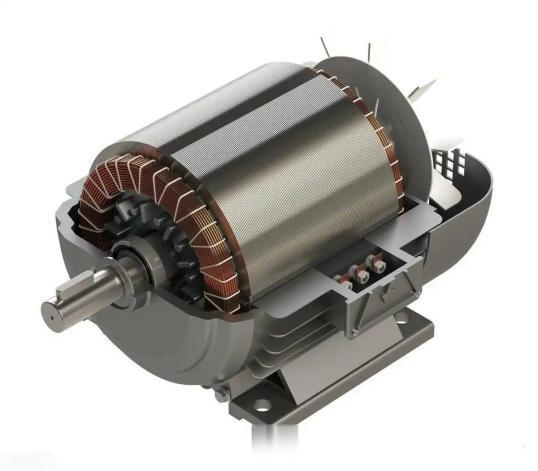
An electric vehicle can maintain high torque at low speeds due to the placement of magnets within the rotor. The key technology behind modern electric vehicles and high-performance industrial drive systems is the Interior Permanent Magnet Motor (IPM).
In the era of new energy vehicles, IPM technology is gaining more attention from motor design engineers and EV drive system purchasing specialists. The working principle of IPM, and the key difference with the surface-mounted permanent magnet motor (SPM) will be explained in the following.
The choice between IPM and SPM is one of the most important decision in electric vehicle design as the difference in magnet position determines motor torque output, efficiency curve, and high-speed reliability.
The foundation of permanent magnet motors: The role of the rare-earth magnet
Permanent Magnet Motor (PM) , as a type of alternating current motor, generates a magnetic field by magnet embedded or mounted on the surface of the rotor. For electric vehicles, Permanent Magnet Synchronous Motor(PMSM) is widely used due to its high torque density and efficiency, making it one of the most common types of drive motors.
The motors are generally equipped with a neodymium magnet (Nd FeB), which is called a super-strong magnet in the industry. A neodymium magnet is able to provide a significant magnetic output even with a small size because the magnetic field is concentrated with a high magnetic field strength per unit area.
Because of the high efficiency and high magnetic flux density, the use of permanent magnets can reduce the size of the motor to just one-third of the traditional models while maintaining the same level of performance. It enables electric vehicles to be lightweight designed, and reduces the overall energy consumption of the vehicle by high efficiency. Besides, the magnetic lifespan of rare-earth magnets can last for approximately 400 years, which can ensure the motor functions with stable performance throughout the entire service life.
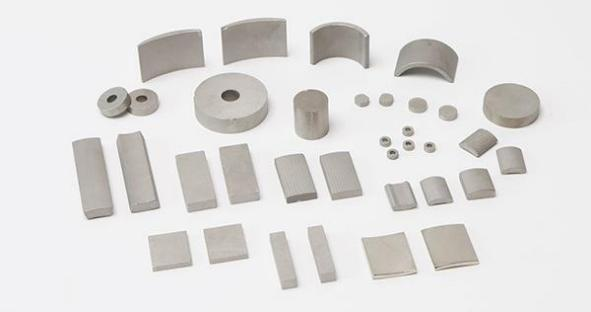
Other than neodymium magnet, samarium cobalt (SmCo) magnet will also be used in some high-temperature applications. The magnetic strength is slightly weaker than that of neodymium, but it is suitable for applications with operating temperatures that frequently exceed 150°C because of the high-temperature resistance. As temperature fluctuates in the operating environment of EV drive motors, magnetic strength and thermal performance should be considered in magnet selection.
IPM and SPM: determined by the position of the magnet
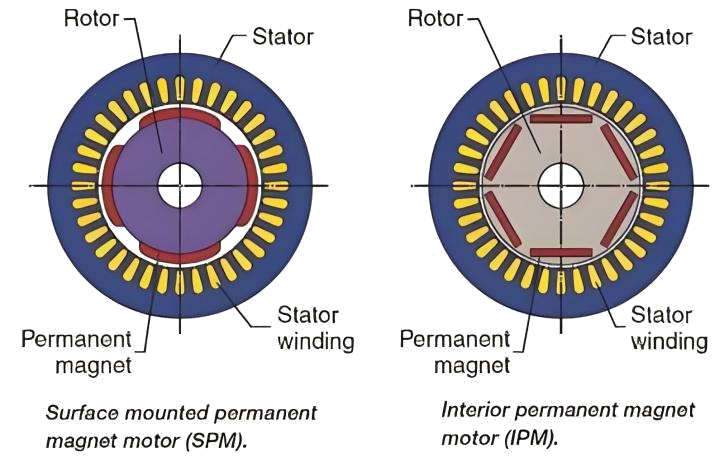
There are two types of permanent magnet motor, which are IPM and SPM. Both of them generate magnetic flux through permanent magnets, but the location of the magnet is different. IPM embeds magnets inside the rotor, while SPM mounts magnets directly on the surface of the rotor. The structural difference changes the performance characteristics, control strategies, and field of application of the two types of motor, which is one of the most signature classification for electric motor design.
The rotor structure is relatively simple in SPM from the perspective of manufacturing. Magnet is directly embedded on the outer surface of the rotor, with carbon fiber or stainless steel sleeves for protection in some designs, which can prevent the magnet detachment due to centrifugal force during high-speed rotation. The rotor manufacturing process of IPM is more complicated. Machining of magnet slots inside the core is required as motor performance can be affected by the placement and angular precision of the embedded magnets, which is one of the reasons for the high manufacturing cost.
The shapes of the two magnet designs are also different. SPM mostly uses ring or arc magnets, while rectangular or cuboid magnets with machined slots are used in IPM. Besides, there are studies showing that IPM requires only 66.7% of magnet material used in SPM, which provides a cost advantage under the increasing price of rare earth.
The transformation brought by hybrid and electric vehicles
The high-speed performance is the greatest advantage of IPM, which is important in the field of vehicle applications. On the other hand, the power-speed curve of SPM is hyperbolic in shape, which means that it progressively increases to a constant power plateau across a narrow speed range, and decreases afterwards. The SPM is dominant in the market of permanent magnet motors before, but it has changed recently. The demand for IPM increases due to the rise of hybrid and electric vehicles. The IPM motor is able to maintain a constant power output with a wide speed range, and therefore is suitable for applications such as traction motors and auxiliary motors.
The advantage of an IPM motor is more clear in vehicle applications, as it provides better control of the magnetization state of the magnetic circuit, which results in a wider range and consistent torque output. Therefore, by changing the current, the operational performance of electric motors can be controlled, which is an essential technology in modern electric vehicle drive systems.
Market demand of IPM is expected to increase over the next decade with the increasing global EV adoption rate. Almost all of the next-generation EV platforms in major automotive brands use IPM as the main drive motor, and the trend is expected to strengthen the dominant position of IPM in the traction motor sector.
Structural properties of SPM
Magnets are mounted on the surface of the rotor, in which the mechanical strength is relatively low. This structure limits the maximum safe operating mechanical speed of the motor. Besides, the inductance value measured at the rotor end is a constant regardless of the position of the rotor, which makes the generation of torque by SPM mainly rely on the single mechanism of magnetic torque.
Despite these performance limitations, SPM has been widely used in applications that do not require strong mechanical strength, such as household appliances and low-speed water pumps, because manufacturing is simple and costs are lower.
Structural advantages of IPM
The structure of IPM that embeds the magnets inside the rotor leads to better mechanical performance, and therefore, it is suitable for high-speed applications. They have a relatively high Lq/Ld inductance ratio, which is a key indicator to measure the magnetic reluctance difference along different rotor axes.
IPM can generate torque by both magnetic torque and reluctance torque mechanisms because of its structure, which enables adaptation to the different needs of electric vehicles. An ideal torque output can then be maintained from driving at low speeds in the city to high speeds on the highway.
The control strategy of maximum torque per ampere (MTPA) is usually adopted to fully utilize the dual-torque advantages of IPM. Both the magnetic torque and reluctance torque sources should be kept balanced by dynamic adjustment of the current vector for optimal efficiency output. Therefore, the control algorithms for IPM, which require more precise sensors and computing power, are more complicated than those for SPM.
Future direction of IPM and SPM
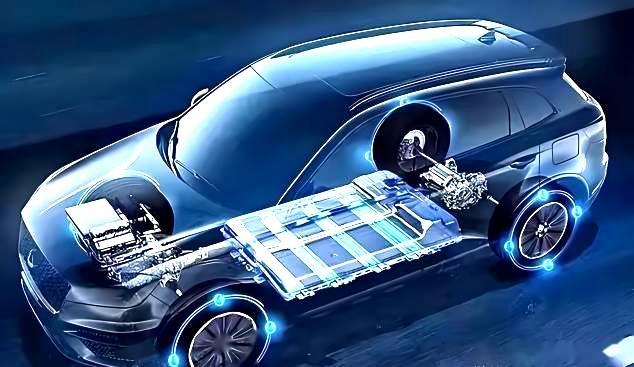
IPM is a preferred option for high-speed applications such as traction motors, as it can deliver comparable torque output with less magnet material. Other than magnetic torque, reluctance torque is also utilized in IPM to generate high torque output. Vector control technology is also applied in IPM to adapt to different changes in demand during the operation of high-speed motors.
In the comparison of efficiency curves,SPM can achieve high efficiency at low and stable speeds due to the simple magnetic circuit design, while IPM can maintain high efficiency over a broader speed range. Therefore, the efficiency of IPM is higher at high speeds. High efficiency over a wide speed range can be maintained in IPM by adjusting the magnetization state of the magnetic circuit. The magnets are encapsulated inside the rotor and will not detach by centrifugal force. Therefore, mechanical reliability is improved because of the high durability of the overall rotor structure. IPM can save about 30% in energy consumption compared to traditional designs under the same power output, which is an attractive advantage for the EV industry that is focusing on driving range and energy efficiency.
The use of field weakening technology of IPM during high speed can weaken the effective magnetic field of the rotor after exceeding the basic speed, which allows the motor to maintain constant power output across an extended speed range. As a result, high efficiency of electric vehicles can be maintained, whether in low-speed climbing or high-speed cruising, and this is why IPM is popular in the new energy vehicle sector.
How to choose?
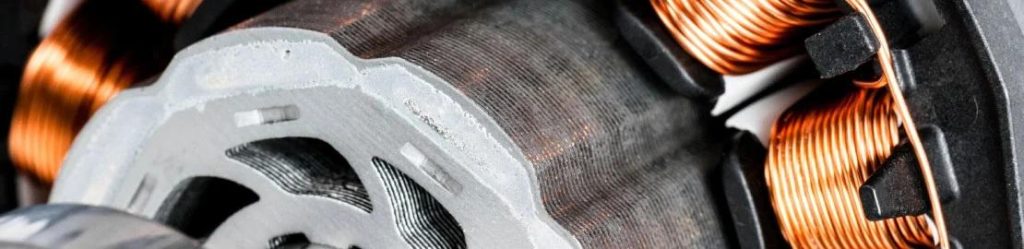
For the application that does not require a wide speed range, or budget is a primary consideration, SPM should be chosen because of its simple structure and lower cost.
If high efficiency across a wide speed range is required, particularly for applications involving high-speed operation and strong torque demands, such as EV traction motor or new energy applications, IPM should be considered due to its high-speed performance, higher torque density, and better mechanical reliability.
A certain degree of heat dissipation is provided in IPM due to the core encapsulation structure, which maintains the magnet at lower temperatures and prevents magnetic performance degradation by high temperatures. In contrast, poor heat dissipation is provided in SPM due to the direct exposure of magnets. It is also why IPM is preferred for high-power-density applications.
In conclusion, for applications with low requirements on speed range and torque consistency, such as household appliances and low-speed water pumps, SPM is preferred due to the cost advantage. For traction motors or industrial drive systems operating over a wide speed range, although the initial cost of using IPM is high, it can be covered through long-term efficiency gains and reduced usage of magnet materials.
Before making the decision, it is recommended to communicate with the magnetic material supplier about the operational needs, such as target speed and budget limits. It can ensure the most suitable option can be chosen without redesigns caused by specification mismatches in the future.


 English
  Spanish
  French
  Italian
  Portuguese
  Arabic
  Turkish
  Chinese
  Vietnamese
  Thai
Thai  Japanese
  Korean