
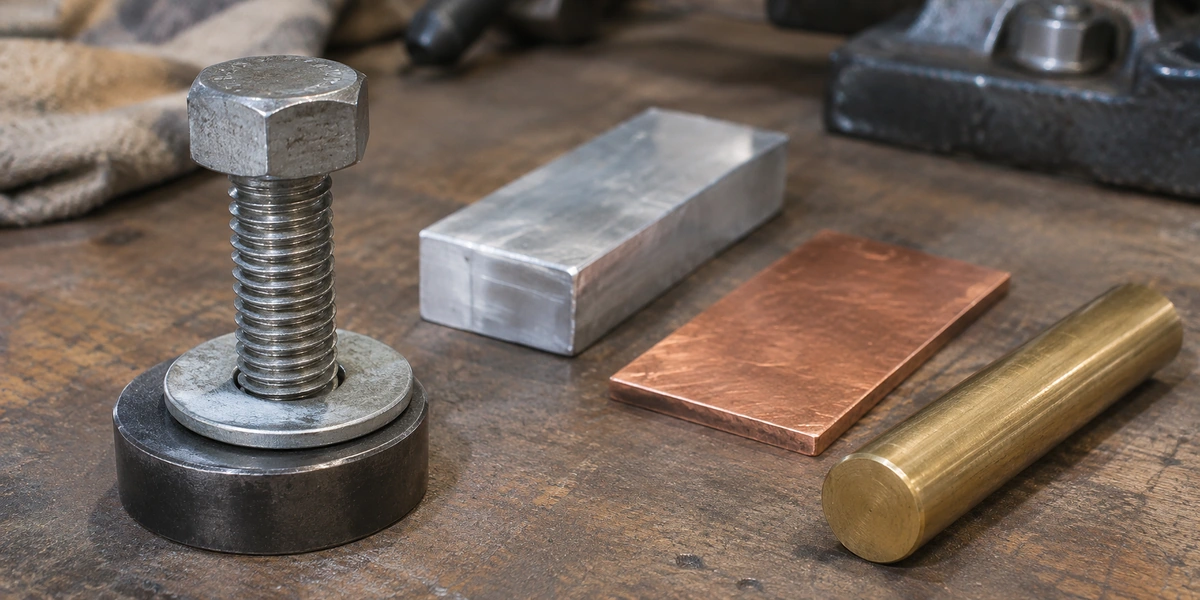
Pick up a magnet and place it against a steel washer. It sticks immediately. Try the same thing with a piece of aluminum, and the magnet falls away. A stainless steel kitchen sink might give a different result again, depending on the grade of steel used to make it.
This simple test raises a question: why do some metals attract magnets while others do not?
Magnets stick to iron, nickel, cobalt, and many alloys containing these elements. Carbon steel, most types of cast iron, and several grades of stainless steel are also magnetic. Metals such as aluminum, copper, brass, gold, and silver show no noticeable attraction during an ordinary magnet test.
There are exceptions, particularly when dealing with metal alloys. The chemical composition of a metal tells only part of the story. Its internal structure and manufacturing history can make a considerable difference.
Which Metals Will a Magnet Actually Stick To?
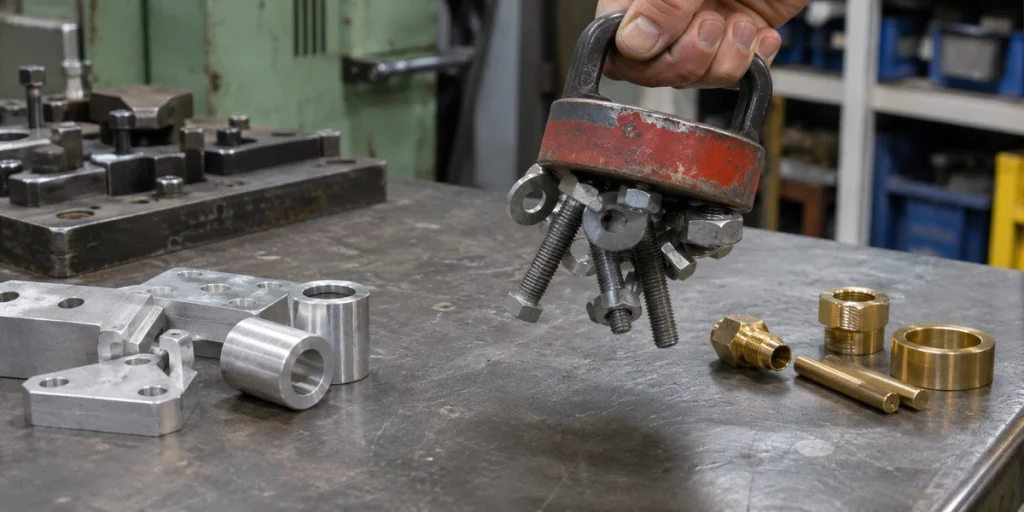
Most magnetic metal objects encountered in workshops, factories, and households are made from iron-based materials. Pure magnetic metals are less common in everyday products, although they are important in the production of permanent magnets and electrical equipment.
الحديد
Iron is probably the easiest example to understand. At room temperature, it responds strongly to a magnetic field and can become magnetized.
Pure iron is relatively soft compared with many engineering steels. As a result, manufacturers often use iron-based alloys rather than pure iron when mechanical strength is also required.
In electromagnetic equipment, however, soft iron remains valuable because it can be magnetized and demagnetized relatively easily.
Nickel and Cobalt
Both nickel and cobalt are naturally ferromagnetic at room temperature.
Nickel presents an interesting example. Although pure nickel is magnetic, adding it to another metal does not necessarily make the resulting alloy magnetic. In stainless steel production, nickel can help stabilize a crystal structure that shows very little attraction to a magnet.
Cobalt is more closely associated with specialty magnetic materials. It forms part of samarium cobalt magnets and AlNiCo magnets, both of which have applications where temperature stability or particular magnetic characteristics are required.
Carbon Steel
If a magnet sticks firmly to a bolt, machine enclosure, steel bracket, or structural beam, there is a good chance the object is made from carbon steel.
Low-carbon steel is particularly useful in magnetic assemblies. A steel backing plate, for instance, can help guide magnetic flux through a component instead of allowing as much of it to spread into the surrounding space.
Not every steel part responds with the same strength. Alloy composition, heat treatment, and component geometry all influence the result.
Cast Iron
Ordinary gray iron and ductile iron are generally magnetic. This explains why magnets stick to many cast machine housings, engine blocks, and industrial pump components.
The response may differ from that of a solid mild steel plate. Graphite content and the structure of the metallic matrix affect the magnetic properties of cast iron.
Specialty cast irons, including certain high-nickel austenitic grades, may show much weaker attraction.
Magnetic Alloys
Some alloys are manufactured specifically for their magnetic behavior rather than their structural properties.
Neodymium iron boron, samarium cobalt, iron-silicon, nickel-iron, and aluminum nickel cobalt are examples. Their properties differ substantially, which is why an alloy suitable for a transformer core may be unsuitable for a permanent magnet.
Why Are Some Metals Magnetic and Others Not?
The difference comes down to what happens inside the material.
In ferromagnetic metals, neighboring atomic magnetic moments interact in a way that allows them to align collectively. Small regions called magnetic domains can change their orientation when exposed to an external magnetic field. This produces the strong attraction associated with iron and ordinary steel.
Other metals behave differently.
Aluminum and titanium are paramagnetic, meaning they experience weak attraction in a magnetic field. Copper, silver, and gold are diamagnetic and develop a weak response opposing the applied field.
Both effects are generally too small to observe with a household magnet.
The familiar distinction between magnetic and non-magnetic metals is therefore a practical one. A material described as non-magnetic can still interact with a magnetic field; it simply does not behave like ordinary iron or steel.
Magnetic and Non-Magnetic Metals: A Quick Reference
The table below shows what to expect when common engineering metals are tested with a permanent magnet at room temperature.
Metal or Alloy | Magnetic Attraction | Common Uses |
الحديد | Strong | Electromagnets and magnetic cores |
Nickel | Noticeable | Specialty alloys and coatings |
Cobalt | Noticeable | Permanent magnet materials |
Mild steel | Strong | Fabrication and magnetic assemblies |
Gray cast iron | Generally strong | Machinery and engine components |
430 stainless steel | Strong | Appliances and industrial panels |
410 stainless steel | Strong | Shafts and valve components |
304 stainless steel | Usually weak or negligible | Food processing equipment |
316 stainless steel | Usually weak or negligible | Chemical and marine equipment |
2205 duplex stainless steel | مغناطيسي | Offshore and process equipment |
الألومنيوم | Negligible | Transportation and electronics |
النحاس | Negligible | Wiring and electrical components |
النحاس | Negligible | Fittings and connectors |
التيتانيوم | Negligible | Aerospace and medical equipment |
الزنك | Negligible | Protective coatings |
ذهب | Negligible | Jewelry and electrical contacts |
فضي | Negligible | Electrical contacts and jewelry |
The table describes typical behavior, not a guaranteed test result for every alloy or manufactured component.
Why Stainless Steel Is an Exception
Stainless steel is where a straightforward magnet test often becomes misleading.
Consider two stainless steel sheets, one made from grade 304 and the other from grade 430. Their surfaces may look almost identical, particularly after polishing. A magnet, however, will normally stick much more firmly to the 430 sheet.
The difference lies in their metallurgical structures.
Stainless Steel Family | Common Grades | Magnetic Behavior |
Austenitic | 304, 316, 316L | Usually non-magnetic or weakly magnetic |
Ferritic | 409, 430, 444 | مغناطيسي |
Martensitic | 410, 420, 440C | مغناطيسي |
Duplex | 2205, 2507 | مغناطيسي |
Precipitation Hardening | 17-4 PH | مغناطيسي |
There is another complication. A piece of annealed 304 stainless steel may show almost no attraction before fabrication. After bending, stamping, or cold drawing, some areas of the same component may become magnetic.
Cold deformation can transform part of the austenitic structure into martensite, which is ferromagnetic. The corners of a pressed stainless steel sink, for example, may respond differently from its relatively flat sections.
Grade 316 is generally more resistant to this transformation, but its magnetic response also depends on composition and processing conditions.
A magnetic stainless steel component is not necessarily inferior. Nor does the absence of magnetic attraction prove that a component is made from high-quality stainless steel.
What About Aluminum, Copper and Brass?
These three materials frequently appear alongside steel in fabricated products and industrial equipment.
Aluminum does not provide a suitable attachment surface for an ordinary holding magnet. This becomes relevant when manufacturers replace steel machine covers or access panels with aluminum to reduce weight. Existing magnetic catches may no longer work unless a steel strike plate is added.
Copper behaves differently from iron, too, but it can still interact with a moving magnetic field.
An interesting demonstration involves dropping a neodymium magnet through a copper tube. Instead of falling freely, the magnet moves slowly through the tube. Its changing magnetic field induces electrical currents in the copper, which generate a magnetic field opposing the motion.
This phenomenon, known as eddy current braking, does not mean copper has become ferromagnetic.
Brass is normally non-magnetic. A brass-colored screw that attracts a magnet may actually be made from steel with a decorative coating. Appearance alone is not always a reliable indication of the underlying material.
Why Magnetic Attraction Varies Between Metal Parts
Two components made from the same grade of steel can produce noticeably different magnetic holding forces.
Take a small holding magnet and place it against a thick, unpainted steel plate. Now move it onto a thin, powder-coated steel enclosure. The second surface may provide considerably less holding force, even though both components are made from magnetic steel.
Several physical conditions account for the difference.
Metal thickness. A thin steel sheet may reach magnetic saturation before the available magnetic flux can be carried effectively through the material.
Surface coatings. Paint, powder coating, plastic coverings, and protective finishes introduce separation between the magnet and the steel.
Contact area. A flat magnetic surface generally makes better contact with a flat steel plate than with a curved pipe or an irregular casting.
Temperature. Permanent magnets can lose magnetic strength at elevated temperatures. The extent of this loss depends on the magnet material, grade, and working conditions.
Magnet manufacturers often measure pull force using thick, flat steel plates under controlled conditions. The values obtained in those tests should not automatically be treated as the holding force available on an actual machine component.
What a Simple Magnet Test Can Tell You
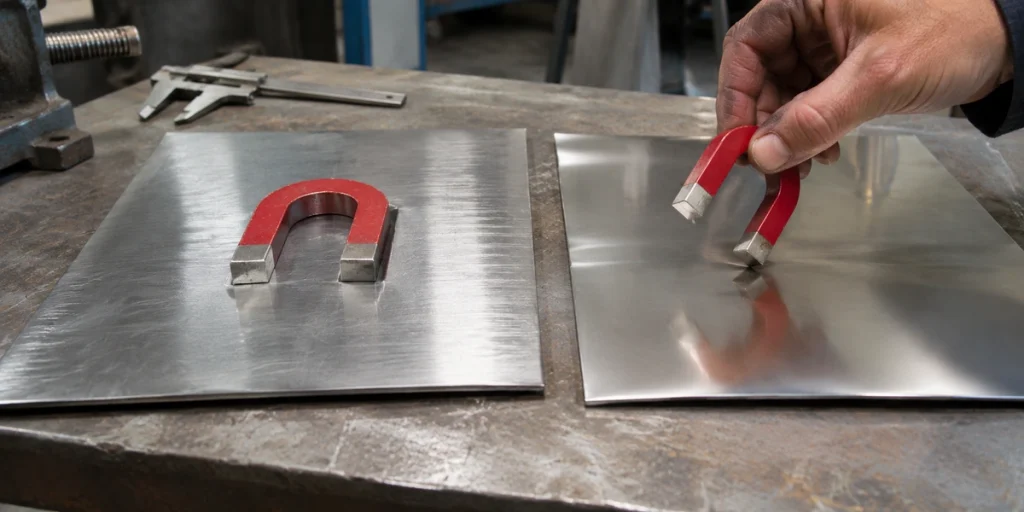
A handheld magnet remains a useful tool for sorting metal parts. It requires no specialized equipment and provides immediate results.
When checking an unfamiliar component, test more than one location. Welded joints, bent sections, fasteners, and surface coatings may influence the response.
A strong attraction suggests that ferromagnetic material is present. Weak attraction deserves further investigation, particularly with stainless steel. No noticeable attraction rules out many common magnetic metals but does not establish the exact material grade.
A magnet cannot reliably distinguish grade 304 stainless steel from grade 316. It also cannot confirm the carbon content of steel or establish the purity of precious metals.
Where material identification matters, chemical composition analysis, positive material identification (PMI), and appropriate laboratory tests are more reliable.
Choosing Metals for Industrial Magnetic Applications
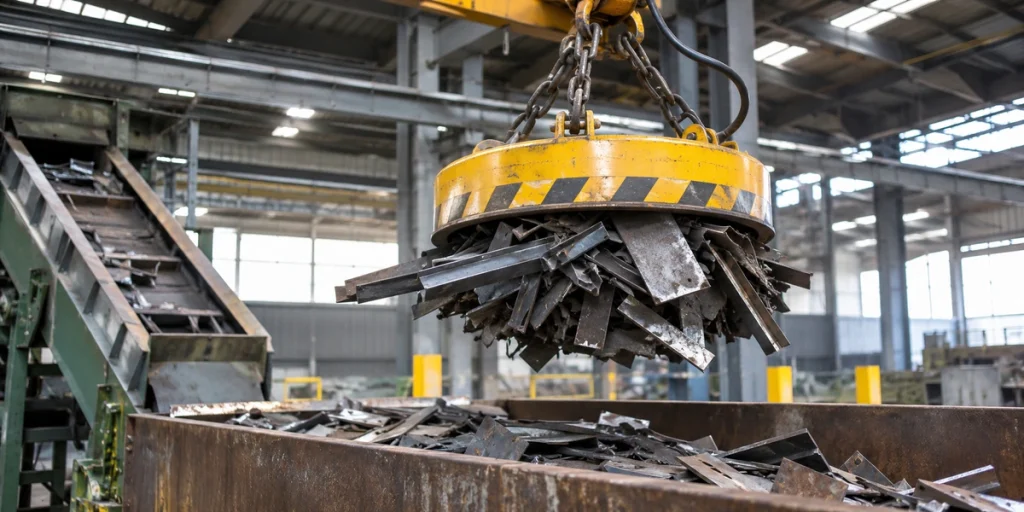
A magnetic material used in an electrical motor has a different job from the steel plate attached to a magnetic lifting device.
In motors, transformers, and electromagnetic assemblies, soft magnetic materials are selected because they respond readily to changing magnetic fields. Electrical steel is often used in motor and transformer cores, where controlling magnetic losses is important.
Permanent magnets have a different requirement. Materials such as NdFeB and SmCo must retain their magnetization after the external magnetizing field has been removed.
طلب | Typical Material | Main Requirement |
Motor cores | Electrical steel | Low magnetic losses |
Permanent magnet motors | NdFeB, SmCo | Stable magnetization |
Magnetic separators | Permanent magnets and steel components | Effective particle capture |
Electromagnets | Soft iron, low-carbon steel | Easy magnetization |
Magnetic holding fixtures | Low-carbon steel | Reliable holding force |
High-temperature magnetic assemblies | Suitable SmCo grades | Thermal stability |
For a magnetic fixture, the condition of the workpiece can be just as important as the magnet itself.
Before specifying a stronger magnet, check whether poor contact, insufficient steel thickness, or a protective coating is responsible for the reduced attraction. Changing the steel backing plate or improving the contact surface may solve the problem without increasing the magnet size.
For load-bearing or lifting applications, use equipment rated for the actual load and operating conditions rather than relying on a simple pull-force test.
الأسئلة الشائعة
Do magnets stick to galvanized steel?
Yes. Galvanized steel has a protective zinc coating over a steel substrate. Although zinc itself shows no noticeable attraction, the underlying steel remains magnetic.
Why does a magnet stick to my stainless steel sink?
The sink may be made from magnetic stainless steel, or its manufacturing process may have introduced magnetic regions through cold deformation. Attraction around pressed corners is not unusual.
Can a neodymium magnet attract aluminum?
Not strongly enough to hold it in place under ordinary conditions. A moving neodymium magnet can, however, generate eddy currents in aluminum and produce measurable forces.
Does rust affect magnetic attraction?
Yes. A heavily corroded surface may reduce holding force because it interferes with direct contact between the magnet and the underlying steel. Loose rust and uneven surfaces can make the effect more pronounced.
Can a magnet distinguish real gold from fake gold?
Not reliably. Strong attraction may indicate the presence of magnetic base metals, but many imitation gold materials are also non-magnetic. Additional testing is necessary to establish authenticity.
Are all magnetic metals permanent magnets?
No. A steel washer can attract a magnet without being a useful permanent magnet itself. Permanent magnet materials are selected for their ability to retain magnetization and resist demagnetization.
خاتمة
An ordinary magnet works well for identifying most carbon steels, iron castings, and other ferromagnetic components. Stainless steel requires more caution, particularly when the material has been cold worked or fabricated.
For industrial applications, knowing that a metal is magnetic is only the first step. The actual workpiece, including its thickness, surface finish, geometry, and operating temperature, should be considered before selecting a magnetic component.
A magnet that performs well on a laboratory steel plate may behave quite differently on the production floor.



 Arabic
 English
 Spanish
 French
 Italian
 Portuguese
 Turkish
 Chinese
 Vietnamese
 Thai
 Japanese
 Korean